How to Go from Sporadic Paid Speaking to a Consistent Pipeline of Keynotes: Stage-Side Leads
If you’re not a celebrity, the most sustainable way to get paid to speak isn’t your fame. It’s your game.
(And if you thought that was lame? Same.)
(For the 17 people still reading this, yes, I do think a distinct tone of voice is part of your game. Mine just so happens to be incredibly charming. Right? RIGHT? I’ll move on.)
Today I wanted to write some long overdue advice to people who are the “real deal.” That means you have expertise, good raw material, and at least some traction. There are enough people who want to look the part of a speaker, a thought leader, a successful entrepreneur, but they aren’t interested in genuinely serving other people or bringing earned insight to their work. That’s not you. You’ve got the right mentality, along with…
Expertise: You have a genuine depth of knowledge and experience, whether directly (you’ve done the work) or through investigation (you’ve observed, interviewed, and researched), or if you’re like me, a combination.
Raw material: You’ve done at least some of the work to refine and package your expertise into more than just a “wall of smarts” or personal success story. When I work with clients, this means turning their expertise into one signature idea, aka their premise. Then we use the premise to inform and clarify messaging and content, while crafting IP as we go: signature stories and frameworks, branded terms and methods, and signature speeches and speaker success systems to build a platform and business around the premise and person.
Traction: I’m also considering the best audience for today’s essay to be someone with at least some audience and revenue traction, maybe even sporadic paid speaking. Now the aim is to make speaking consistent and systematic. You want it to become a revenue engine.
This is a meaty, meaningful topic, so we’ll need some scaffolding to navigate things:
FIRST, we need to address what people typically do to scale their speaking. I think all of us tend to focus on the wrong things, or maybe the right things but in the wrong order.
SECOND, I’ll share what you actually need, based on what actually drives opportunities and revenue.
THIRD, given what’s most needed to go from sporadic to systematic speaking, I’ll propose the best two places to focus your time, energy, and investment.
Ready? Here we go…
1. What we (incorrectly) assume we need first to grow our speaking.
Whenever I talk to someone who brings all three of the traits above to the call, they always tell me the same two things:
They invest in a speaker reel
They reach out to speaker bureaus.
This makes some sense. It’s not the wrong stuff per se. But unless you already have a significant foundation of paid keynotes and a decently high fee, these two things aren’t going to help much. In fact, they waste your time and dollars.
To go from sporadic to systematic, yes, you do need video clips of your speaking. Absolutely. That is far and away the biggest miss I see among experts who lean into speaking. I’ve noticed so many people have a speaker page on their websites, but then all they feature are static photos and blocks of text, no examples of them actually speaking. That’s like trying to sell a painting from your site, but instead of showing the actual works you’ve created, you use some text to describe mountain ranges and sunsets.
SHOW ME.
As a speaker, when you step onto the stage, you’re not speaking “at” the event. You ARE the event. That requires an outlandish amount of trust in you from event planners and community leaders. When they’re vetting speakers, it’s not the glossiness of the reel that matters. It’s the ability to speak well, speak with impact, in ways that are entertaining and educational at the same time.
Video clips are far more important (and more affordable too) than a beautiful reel. They get the job done in the same way, arguably better, to show others you’re trustworthy on stage. A reel is meant to elevate an established speaker who is ready to showcase more of their pedigree, fame, testimonials, and signature bits, rolled into a snappy video. Reels are also required if you plan to work through bureaus to get booked. (More on bureaus in a second.)
If you’re looking for a rough idea of when it makes sense to create a speaker reel, unfortunately, I can’t really say. At ANY stage, a reel can help you get booked, but it’s an unnecessarily large, expensive endeavor until you’ve reached a certain scale. It’s like buying the most expensive ride-on lawn mower you can find, tricked out with all kinds of add-on features, with the most possible horsepower. Can that work to mow a tiny lawn? Sure, but I’d much rather buy a machine that fits my actual property better, then when I move homes, I can decide if this new stage of my life requires a monster truck kind of mower.
The right tool for the right stage. The right investment for the right job. You want to go from sporadic to consistent. A reel can help, yes. But so can clips of your talks. That can suffice for many, many years.
In my career, my first reel came 1-2 years into being a full-time professional speaker. That means I was able to support myself and my family for 1-2 years purely on speaker fees before I had any “glossy” reel on my site. I think at that time in my life and the world, that meant doing $75k in speaking fees and charging $12k per gig. But more to the point of my own journey, it meant declaring to the world, this is what I do. I’m not an author and consultant who speaks. I’m an author, consultant, and keynote speaker.
If your goal is pipeline and initial growth to reach a steady state of speaking, then a reel isn’t worth it. Use or collect video clips. That gets you much further than you’d suspect.
And just for fun, here’s my latest reel.
They’re super fun. I get it. But resist until you’re at scale.
Next, let’s talk about speaker bureaus briefly.
Just like your reel (and other elements of “fame”), bureaus are about scaling existing scale, if that makes sense. Bureaus can help! But they aren’t required. They’re also the most helpful when you understand their incentives. They are sales organizations. They take a cut of your fee (typically 20%). When someone from a bureau reaches out about a client event, they won’t disclose the relationship (which I don’t love, because I’m a far better servant and more likely to book a gig if I’m involved in the sales process and can connect with the event organizers interpersonally, not just through my marketing materials, to say nothing of the need to customize session descriptions based on what the organizers tell me on those calls).
Instead what happens is you get very little detail about the event (date, industry, maybe the name of the organization), and you’re asked to put a “hold” on your calendar. When you do, you may never hear back from that sales rep ever again. You’re forced to follow up yourself to learn what happened, or else assume you didn’t get the gig. Because most bureaus will batch-sell speakers, especially the non-celebrities of the world. “How about these five speakers? Oh, you didn’t like them? How about these five?”
Again, they are sales orgs. It’s not good or bad. It just is what it is. They are incentivized to act a certain way given their business model. Knowing that clearly helps you navigate it.
It also helps you see: bureaus aren’t useful for getting you traction or growing bookings from sporadic to consistent. Bureaus help manage and scale what is already built. That’s their business model.
I remember the first bureau to book me. They helped me see this clearly. When they asked for my fee, they asked if it was “commissionable,” which is an industry insider way to ask, “Is that number your take plus my take too?” If I said yes, they’d quote that number to the client. If I said no, they’d add 20% over the top (hopefully not more), then quote the new, higher number to the client. But was I able to charge that really? It threw me for a loop. The actions they took align with their business—just not mine at the time.
(Since then, I’ve had a mix of wonderful and horrible experiences with bureaus. That’s a post for another day. The right bureau partner is incredible! The average bureau isn’t worth your time, especially if you know how to generate leads and book directly. But again, ALL bureaus are helpful once you have existing scale. They won’t help you achieve it.)
(Substitute “bureau” for “management company,” and my advice holds.)
In sum, you don’t need a glossy reel and you don’t need a dedicated bureau (or even any bureaus) to manage and sell you when your goal is to move from sporadic speaking to a consistent revenue engine.
So what do you need?
***
II. What speakers actually need to sustain their paid gigs
Leads. You need leads.
(Okay, seems obvious, but there is some nuance here, which actually helps make paid speaking way more attainable and controllable, like any other business we could start.)
Specifically, you need to be optimizing for one kind of lead, which happily, is a metric that the bullshitters and the pretenders can’t game. It’s a metric that speaks to how genuinely good you are—at the craft of speaking, at the process of serving event organizers, at the business of transforming audiences. In other words, this metric is about your game, not your fame.
Stage-side leads.
I first learned this term from the master, Andrew Davis. A stage-side lead is the lifeblood of a sturdy speaker business. This is true for all speakers at all stages, but it’s especially crucial for folks moving from a handful of paid gigs here and there to something more predictable and scalable.
Stage-side leads are the people who approach you after seeing you speak today with an opportunity to speak tomorrow. They might rush up to you immediately (literally, at the side of the stage) or in the hallway after. Maybe they speak to you over lunch at the event. Maybe they email or DM you virtually. Maybe they come back to you weeks or months later. Regardless, a stage-side lead is a branch from a trunk. You turn today’s gig into many more gigs.
That’s why it’s so crucial to have a good process before, during, and after a single speech. You can’t just fly in, give a talk, and fly out. Not only is that a poor way to serve event clients and attendees, it’s bad for your business! I always tell people expressly in my quote that my price contains my attendance for the day. I sit in other sessions. I go to breakfasts, lunches, and happy hours. Heck, the client can ask me to sit on or even emcee a panel after my talk, if they’d like, or they can ask to interview me for their content or a key partner’s, or just introduce me to key VIPs they want to meet and impress.
As a speaker, you’re there to serve everyone at the entire event for at least the full day, if not more.
That’s also how to grow your lead pipeline too!
Why stage-side leads matter so much:
The best leads are stage-side leads:
They arrive the fastest. No waiting or wondering. When you do this work right, people literally rush up to you with an opportunity. (“Oh my gosh, I loved your talk! Hey, my company has an event coming up in October. I’d love to talk to you about speaking there.”)
They pay you the most. They just spent 45-60 incredible minutes immersed in your thinking, loving your stories and humor and insights and frameworks. They’re all the way in. They “get it” like few do. Your (ever-increasing) speaker fee is a no-brainer.
They platform you everywhere. Podcast interviews. Quotes in articles. Mentions to others everywhere they go, both at the event (hallways, their own talks, etc.) and back at home to peers and colleagues and bosses.
They buy more than just your talk. Do you sell books? They’ll buy it for themselves and gift it to others, and maybe even buy several boxes if you speak for them. Do you offer workshops? They’ll ask if you can bundle it with a keynote for an even higher fee. Do you sell courses? They’ll buy some seats.
They support you passionately. They’ll subscribe to your content and share it. Post about your talk on social media. Suggest you in comments when someone posts to LinkedIn asking about good people to interview or speakers to book.
Stage-side leads are everything to your speaking business, and we must optimize everything for that one metric.
Again, this is true at all stages, but it’s especially true for non-celebrities looking to charge five-figures for their speaking and book consistent revenue as a keynote speaker.
Stage-side leads keep the flywheel turning faster and fill the pipeline more easily. They’re how you turn one gig into several. You don’t need to hope and pray leads come to you—magically, online, through a form, email, or DM. You don’t need to cold pitch new relationships every time you want to book a speech. (BTW: breakouts pitch; keynotes get invited. If you want to get paid, you need the invite.) Thanks to your stage-side leads, you build a viable, growing speaker business.
In fact, you could do nothing else online to grow your platform and still have a growing speaker business, if you knew how to reliably generate stage-side leads.
Of all the things we “need” as a speaker to scale our businesses and maintain our pipelines, this is the big one. The rest could fall away, and if stage-side leads continue, you’re doing great.
***
This all leads to one final question today: if we need stage-side leads above all else, how do we get them? On the giant list of things we could create, invest in, and do, what comes first?
I’ve written before about how keynotes operate on an inverted commercial model compared to other things you’ve sold before. In other words, keynotes are sold backwards. In other cases, you invest in all your marketing and selling, then deliver the full offering after someone buys it or hires you. But with speaking, your stage-side leads are sitting in the room today, watching you deliver your entire speaking product first, then they decide to buy it.
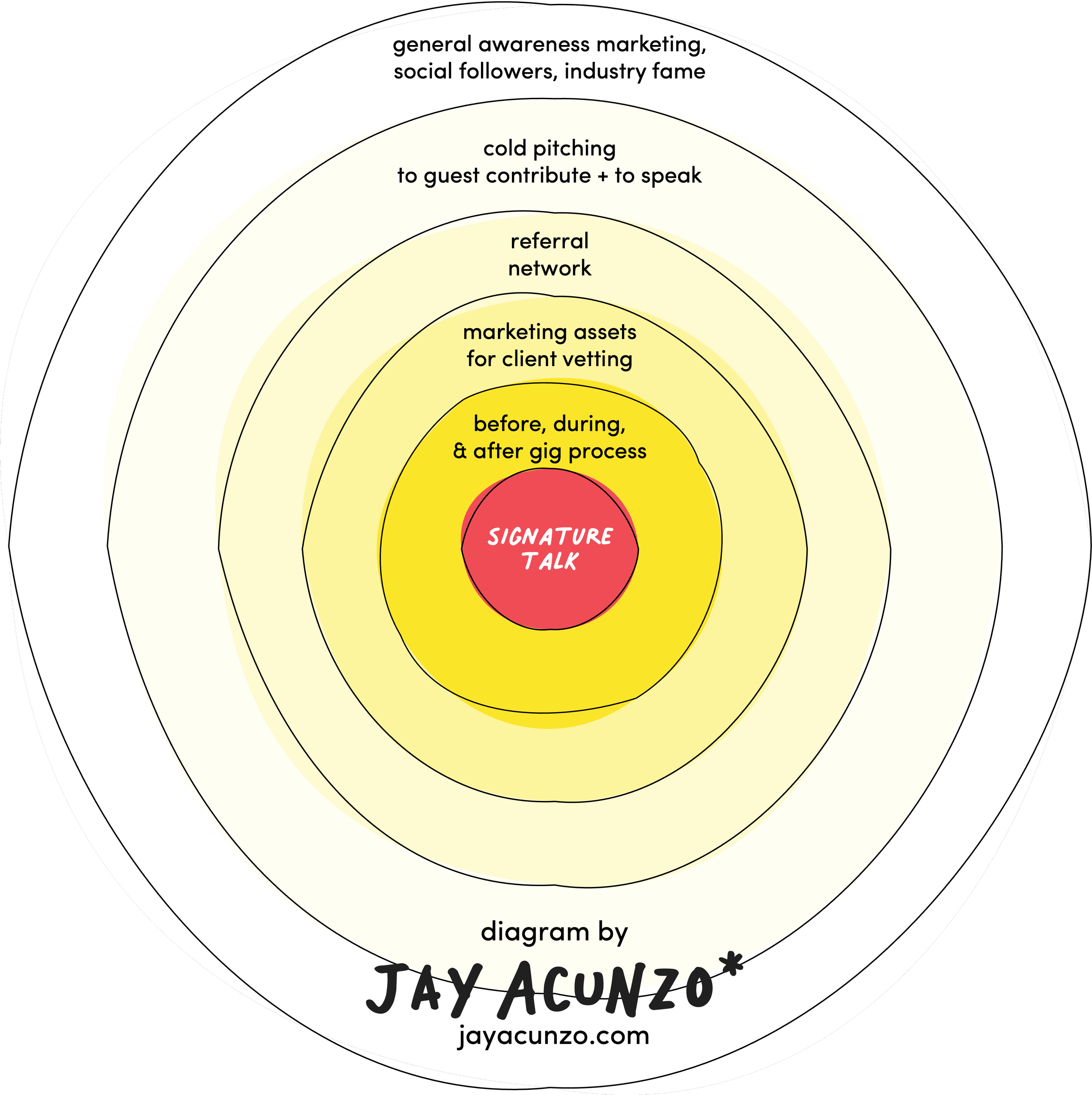
That means your signature talk is not just your product offering on stages. It’s your best sales tool. It’s your revenue engine. Invest where the revenue comes from: in keynote speaking, not your marketing and selling online or through cold pitches, but the talk itself.
To go from sporadic to systematic in your paid speaking, focus on the biggest needs to actually attain and scale revenue:
III. Where to focus your time and dollars (2 things)
If we need stage-side leads, then we need to start work two things. Not fame online or in a niche. Not bureau exclusivity. Instead:
One signature talk
One pipeline gig
Your signature talk is the speaking product you can reliably deliver and predictably use to generate follow-on opportunities. It’s what Andrew Davis calls “your referable speech.”
In my work with clients, we talk about the “layers” of your signature talk.
It starts with your premise, that ONE signature idea you’re there to own in their minds (and argue for/get buy-in for). A great speech is ultimately a great argument to embrace a single change. Your premise is the idea you want them to embrace.
Once you know the premise, you construct the argument around it, arriving to the second layer: your talk’s structure. I suggest starting with the argument itself. (What are you saying to the audience and in what order to get them to embrace your premise? Try this exercise.) Then you can add a stronger opener and closer to book-end the argument.
From premise to structure, we arrive at content. This is all the IP you’ve built and ideally validated in the market through content and conversations, which you can now neatly arrange into the structure of an effective narrative argument.
And finally, the last layer, performance. Can you embody and deliver your content in your own unique, personalized way? Here’s one of my favorite discussions about this topic with Hall of Fame keynote speaker, Scott Stratten.
A pipeline gig is a speaking engagement full of possible stage-side leads.
As you develop your signature talk, you should be pitching your next pipeline gig (if you don’t have any booked right now).
A pipeline gig is the next thing you need.
A pipeline gig attracts attendees who can hire you to speak. In my early years of speaking, that meant marketing events like Content Marketing World or B2B Forum. The attendees are a diverse array of marketing leaders and practitioners, agency owners and creators, as well as lots of peer-level speakers. (A referral network of speakers is another lifeblood of public speaking, because most speakers are wonderful allies and supporters of their peers! Speakers help speakers get speeches.)
A pipeline gig is different than what I call a “backstop” gig, where my back is against the wall. I can go nowhere else from that one gig. For instance, speaking at Zillow’s annual marketing meeting is a pipeline gig. Everybody there works for Zillow. They aren’t rushing up to hire me for their event in the fall.
If you don’t have a pipeline gig, again, you’ll need to pitch to speak at one or get referred. In most cases, you won’t get paid to speak there, but the lifetime value of that gig in total revenue is high thanks to what follows. (A backstop gig doesn’t have much lifetime value. The value is that gig and that gig alone, at least in terms of speaker fees. Obviously, there are many other benefits speaking to one organization.) Long way of saying, don’t be shy about speaking for free if you are a paid speaker, so long as you know or at least suspect it’s a pipeline gig. If it is, you aren’t actually speaking “for free.”
You’ll book tons of revenue. At least, you’ll book tons of revenue if you focus on the right things in the right order.
Start with the foundations of what actually drives results.
Stage-side leads are the goal.
Your signature talk and initial pipeline gigs should be plenty to get you started.
Then you build your platform and business around that.
The world of paid speaking is nuanced, often opaque, and very difficult to turn into sustainable revenue. It often sends very smart people in the wrong direction, investing in the wrong things. I hope this piece helped clarify what you need to go from sporadic to systematic as you scale your speaking.
The right things, in the right order, for the right results.
Thanks for reading! If you’re new to my work, I help experts and business leaders clarify their ideas and transform their thinking into 1 signature idea (your premise) and their signature IP and speeches—plus all the stories, frameworks, and success systems my clients need to truly own and monetize their ideas.
Here are my best resources for paid speakers.
You can also explore my services here and schedule an exploratory call to work with me here.
Don’t market more. Matter more.
Think resonance over reach.
Don’t be the best. Be their favorite.