How to Book More and Better Keynotes: The Engine Most Speakers Overlook
In 2017, I became the youngest speaker—and by far the least famous person—to open one of the world's biggest, best-known events for marketers, Content Marketing World. On Day 1, I delivered the morning keynote to 4,000 people.
For years, I'd watched as actual celebrities and business leaders with mainstream fame graced that same stage: Tina Fey, John Cleese, Casey Neistat, Joseph Gordon-Levitt, the CMO of GE, the EVP of Innovation at LEGO. I was neither a celebrity nor mainstream-famous. I was barely known in my niche. I was also not an executive at a famous brand whose logo could help the event sell tickets.
But what I did have, my friend ... was a dream.
Just kidding. (Though I did!)
No, what I had ... was a better speech. A signature speech. I had a speaking product I’d worked hard at consistently refining, customizing, delivering, until I could reliably deliver it to any crowd and predictably generate follow-on opportunities for myself and my business. In 2016, the year before my opening keynote, I’d delivered my signature speech in a breakout room at CMWorld, and I became the #1-rated speaker at the whole event that year, according to audience surveys, among 140 total speakers. This earned me an invite to open the entire event the next fall, from the main stage, and so I busied myself in developing another signature talk throughout the year, which I built, tested, delivered countless times to validate and improve, to once again perform at a high level when CMWorld 2017 arrived.
In both cases, 2016 and 2017, my speeches (my signature speaking products) were responsible for my results much more than anything I did online, and I went on to use those two talks to generate hundreds of thousands of dollars in speaker fees on stages across this country and several others.
My friend, I am here today to make the case that investing in the speech itself is the key to your speaking success. Your ideas need to be so high-impact and your speech so proven, you’re undeniable in every room. It’s not just a nice creative exercise to build a better talk. It’s your highest-ROI business activity.
Unfortunately, for one reason I'm about to explain, most entrepreneurs, execs, and business leaders refuse to see this and insist their speech is good enough already. This actually gets worse the more success a person has had in their career, even though it happened away from speaking. I want to change your mindset around this one issue, so that you can book more and better keynotes, charge a fee or raise your rates, and feel less friction and more momentum in building your speaking pipeline.
The success of your speaking depends more heavily on your signature talk than anything you can do to market or sell it.
Most people think it’s an awareness problem or maybe a lack of marketing and sales systems. But no, the tough reality is this:
Your speech isn’t as good as you think it is.
Lest you think, "Jay's a creative, so here he goes, extolling the craft again,” I want to assure you that while I adore the craft (and you should too), this is an essay about sales, marketing, lead-gen, and revenue.
This is also about sequencing your revenue-generating work so you focus on the thing that matters most ... first.
If you want better talks, create a better talk.
If you want more opportunities, less friction, more revenue directly through fees or indirectly through leads, your speech isn't a critical part of the machine. It's the engine.
It’s not just about creative excellence. It’s because of a strange issue most professionals don’t understand when they start to pursue keynotes more fully:
Speeches are sold backwards.
I can break my speaking career in two main halves: my years earning a living mainly on the road as a keynote speaker and a podcast or docuseries host for branded projects, and then the years since, in which I completely reinvented my business to stay home with my kids. I now mainly sell 1:1 advisory services, working with established entrepreneurs and leaders, as well as run my public speaking accelerator.
In both cases, I serve people who bring real substance and expertise to their work, and now they’re on the journey from informational expert to transformational voice. They arrive with plenty of competence, and I help them achieve greater resonance through premise and IP development, signature speeches and speaking success systems, and doing my best to be the Rick Rubin of business storytellers.
In all this time, I’ve seen how nothing kills someone’s success quite like the failure to recognize how sustainable, lucrative speaking happens. Whether you get paid directly or create follow-on interest in other offerings (or both), the same mistake rears its ugly head: they think the problem is their marketing and sales process, when really it’s the speech itself. They tell me they’re focused more on speaking, so they want to build a better speaker page. Create more social videos. Build a flashier speaker reel. Figure out their sales process. You know, the business stuff.
As for their speech?
"Oh, no, that's pretty much there. I mean, I've been winging it for years, and it works fine," or maybe, "It's probably 80%, and I know it can always be better by a little bit BUT," and then they land where I know this plane was headed all along: “I'd rather focus on getting more and better gigs now."
Here's what I've learned: That "little bit" accounts for a huge amount of missed bookings and revenue. It’s the difference between being one of a few dozen breakouts who speak for free at that conference … and being THE keynote who commands a fee.
When it comes to keynote speaking, “good enough” is anything but.
Because speeches are sold backwards.
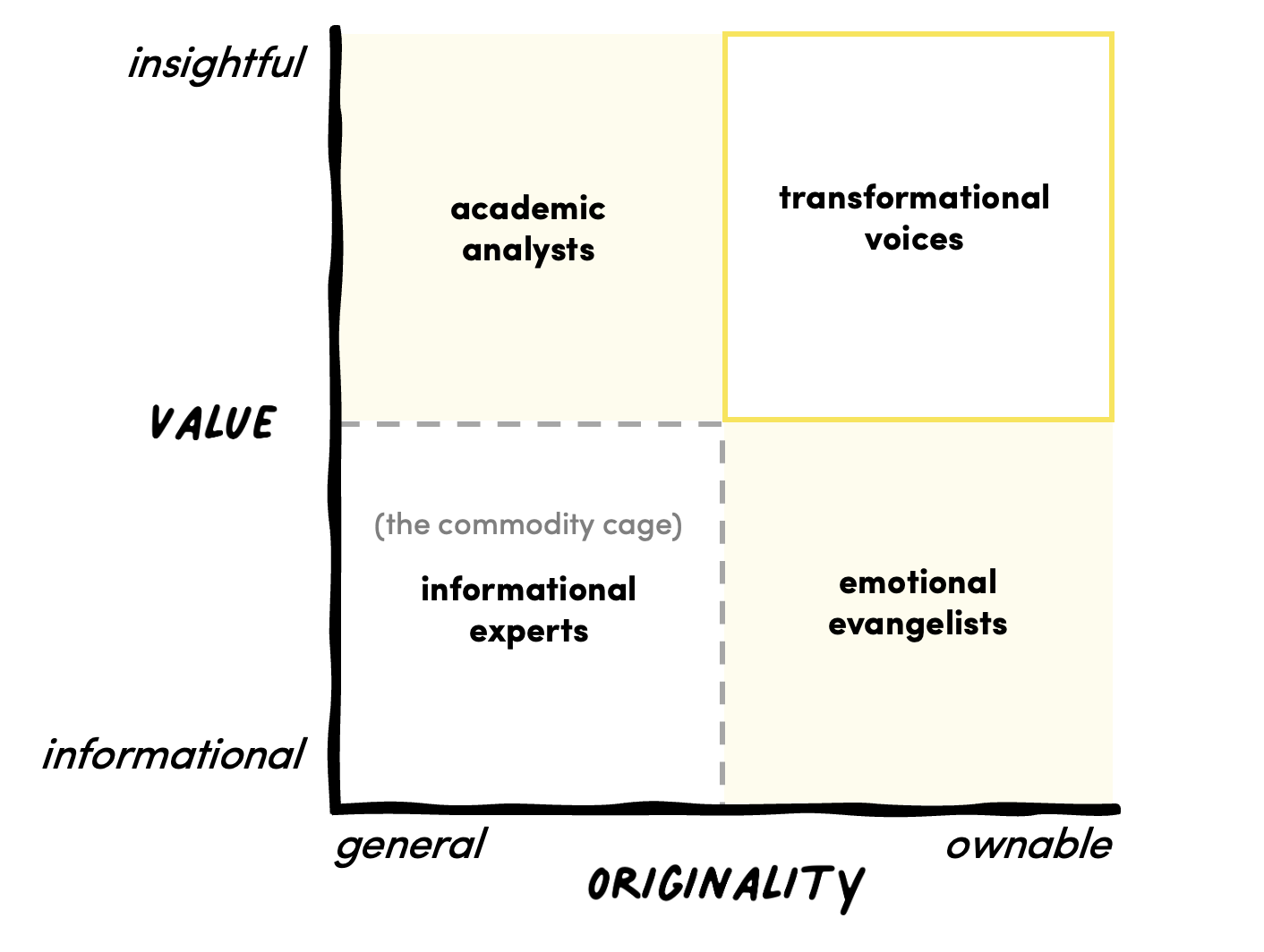
The problem isn't that these people are lazy or that they don't understand the importance of quality. The problem is that everything they've learned about building a successful business has wired them to approach speaking in the exact opposite way they should.
Your marketing instincts are betraying you
Think about every other successful thing you've built. Your consulting practice. Your agency. Your course. Your SaaS product. Whatever it might be. You sell these offerings in the same order:
Create irresistible marketing → Convert prospects into buyers → Then deliver the experience.
As a result, you learned to write copy that speaks to people before they've experienced the product. You've built funnels that nurture the relationship and earn trust over time, in order to get them to buy after. You've crafted messaging and built your brand to create a premium perception and justify charging premium prices, all of which they understand before you close the deal.
And you got good at this. Really good. Good enough that you arrived to this moment, where speaking can even be considered a viable next chapter—or at least a major piece of this one.
That's precisely why keynote speaking breaks your brain.
Because keynotes operate on a completely inverted commercial model—one that betrays every instinct that made you successful everywhere else.
Here's what actually happens as a keynote speaker:
Someone books you to speak. Breakout, workshop, webinar, or keynote. Online or in-person. Big crowd or tiny group. It doesn’t matter. You show up. You deliver your entire product—live, in front of an audience. And sitting in that audience are your next potential buyers. What's more, these people aren’t merely run-of-the-mill leads. They are your best leads and the single-greatest unlock to creating a sustainable, monetizable speaking engine.
The people who already saw you speak close faster. They want your speech in front of their group.
You can charge a higher rate, too, if you charge a speaker fee. They “get it.” Deeply. And they want everything you’re selling. Badly.
They buy your books or say yes to your upsell of a bonus workshop bundled with your keynote for just a small additional fee.
They offer to buy your course for their teams or community members. They invite you onto their shows, quote and link to you around their content, and refer you to others you "really should know" and "gotta meet" because those people need your ideas or even your speech.
Your best leads providing the highest possible lifetime value and the most sustainable path to more lucrative speaking are the people who have already experienced your entire speaking product first.
This means, when we pursue speaking as the thing we sell (for free or a fee), we must shift our mindset from optimizing for this model:
Create irresistible marketing → Convert prospects → Then deliver the experience.
To designing for this one:
Deliver an irresistible experience → Convert prospects → Then deliver the experience again.
The people who see you speak and follow-up with you or refer you to others are called "stage-side leads," and if you want an easier time or greater results when it comes to your speaking, you look backwards for answers, not forwards:
"Why didn't my last gig get me 3 more gigs?"
"Why isn't my speech yielding more invites to speak?"
"Where are my stage-side leads?"
Sometimes they rush up to you then and there or in the weeks after. Sometimes they contact you a year later. Sometimes, you get an email: "Hey, my buddy Steve saw you speak in Phoenix and said you were great! Would love to talk about having you speak to our group..."
It's a tough truth to embrace, but it matters: compared to other things you can sell, speeches are sold backwards. They get your product first, then decide to buy it. Even when you pitch cold, it’s not meant to merely book “a” gig. It’s meant to book a pipeline-feeding gig, one that can branch off into tons of lifetime value—and many more speaking opportunities. If you find yourself pitching, pitch strategically: pitch to kickstart the flywheel of stage-side leads. Target events like industry expos where people sitting there need speakers or know others who do.
Because speeches are sold backwards.
It's like a restaurant where customers eat the entire meal before deciding whether to pay. Or a student attending a school all semester long before choosing whether to enroll and pay any tuition.
It's backwards to every commercial interaction you've likely ever experienced and worked hard to master yourself. That's why your marketing sophistication—the very thing that built your success and prompted you to want more keynotes—is now your biggest liability.
The entrepreneurs who struggle most with this process and who resist my advice the hardest aren't the ones who don't understand marketing. They're the ones who understand it too well.
They're proud of their funnels.
They've built successful lead magnets.
They have an attractive online presence and large following.
They've optimized their site with copy written to convert.
Maybe they even have branded frameworks or concepts people know and share.
But what got you here won't get you there. What worked to sell other things doesn't work as well to sell keynotes. Because speaking flips this model entirely. Because (if I say it enough, maybe it'll stick this time) speeches are sold backwards.
You are completely at the mercy of what you can deliver in that room, in that moment, with those future buyers watching. Jerry Seinfeld put it perfectly: He has said he only gets about five minutes on stage to just "be Seinfeld.” Then he HAS TO deliver. That's the gig. No coasting on prior success. No feeling special because everyone online has complimented you and your success. You're exposed up there. You've got nowhere to hide. Now show me what you've got.
Go inside the speaking and storytelling process of top voices and experts. Follow How Stories Happen.
The closest analogy to selling speeches (the “backwards” approach) might be a free trial of a software product. But even then, both sides understand the product is for sale and the trial expires. Buyers begin the experience knowing, "This thing is for sale, and I am experiencing it first for free while also deciding whether or not I want to buy it at the end." Audiences attending your speech aren't thinking that way. They may have no intention of evaluating you. They just want to learn, feel moved, feel entertained, and implement a lasting change in their work or lives. It's different than software free trials. When someone sits down to watch your keynote, they're not thinking, "I hope this is good so I can decide to book them."
Which means you also need to be so good that they think, "Wow this is so good and I need to book them!"
You have to be so good that, partway through, they're already wondering if they can book you—or afford you. ("Surely, they'll charge a pretty penny to speak for us. Worth it!") That story you just told on stage was the last straw: they immediately search for your contact form. The framework you presented earned you a follower. (Check those DMs. There's an invite to speak for their group awaiting you!) The premise you shared changed their perspective so much, they're already emailing their people. ("We need to book them!")
You've heard the phrase, "Be so good, they can't ignore you," right? In keynote speaking, unless you're an actual celebrity, you have to be so good, they want to book you.
Speaking is much more democratized than we might think and less about fame or marketing systems than we might want to admit. Because it doesn't feel as controllable. Yet it very much is, so long as you invest in the right things, in the right order, testing and validating along the way.
Your speech isn't the creative part that comes after the business work. Your speech IS the business infrastructure.
Moreover, every mediocre speech you deliver actively works against you. That event organizer or business leader who was considering you? They just watched you deliver something forgettable. That podcast host who might have interviewed you? They're not going to stake their reputation on what they just heard. We've all encountered the most impressive people whose online platform and business feels like a 10 out of 10, then they start a speech that immediately feels like a 4. We immediately recoil. It's SO jarring and SO uncomfortable—and SO bad for their speaking pipeline.
Stand-up comedians understand this instinctively. They don't write a set and then immediately focus on marketing themselves to bigger clubs. They work out the material. They test it. They refine it. They know that the act or set itself is the marketing.
But entrepreneurs bring a different operating system. One that says: "I've built successful businesses by creating good-enough products and marketing them brilliantly. Why wouldn't that work here?"
Because here, they watch the whole product before they buy. And no amount of marketing sophistication can overcome a product that doesn't deliver transformation in real-time.
That’s why I tell clients:
🚨 An 80% speech is a 20% business asset.
This isn't about being precious with the craft. This is about focusing on and investing in the things that yield the best results first and most ... then worrying about the rest.
Your marketing brain tells you: "Make the sizzle reel more compelling. Write better copy. Build a better funnel. More social media videos! Automated emails! More pitches! MY AIR GAME CAN STILL GET ME GIGS!"
To that I say, yes, it definitely can. But that’s not the most efficient or effective approach, and that stuff should come later, once the rest is humming. No sense pouring new water into a leaky bucket. When I book a gig, I want to turn that into more gigs. I’m a squirrel already on a tree trunk—why wouldn’t I follow the branches? That’s easier than hurling myself back to the ground and hoping I find another trunk. The ground is a horror show.
Again, investing in your signature talk isn't just a creative exercise. This is about focusing on your highest-ROI business asset.
Where to focus your time, energy, & Money:
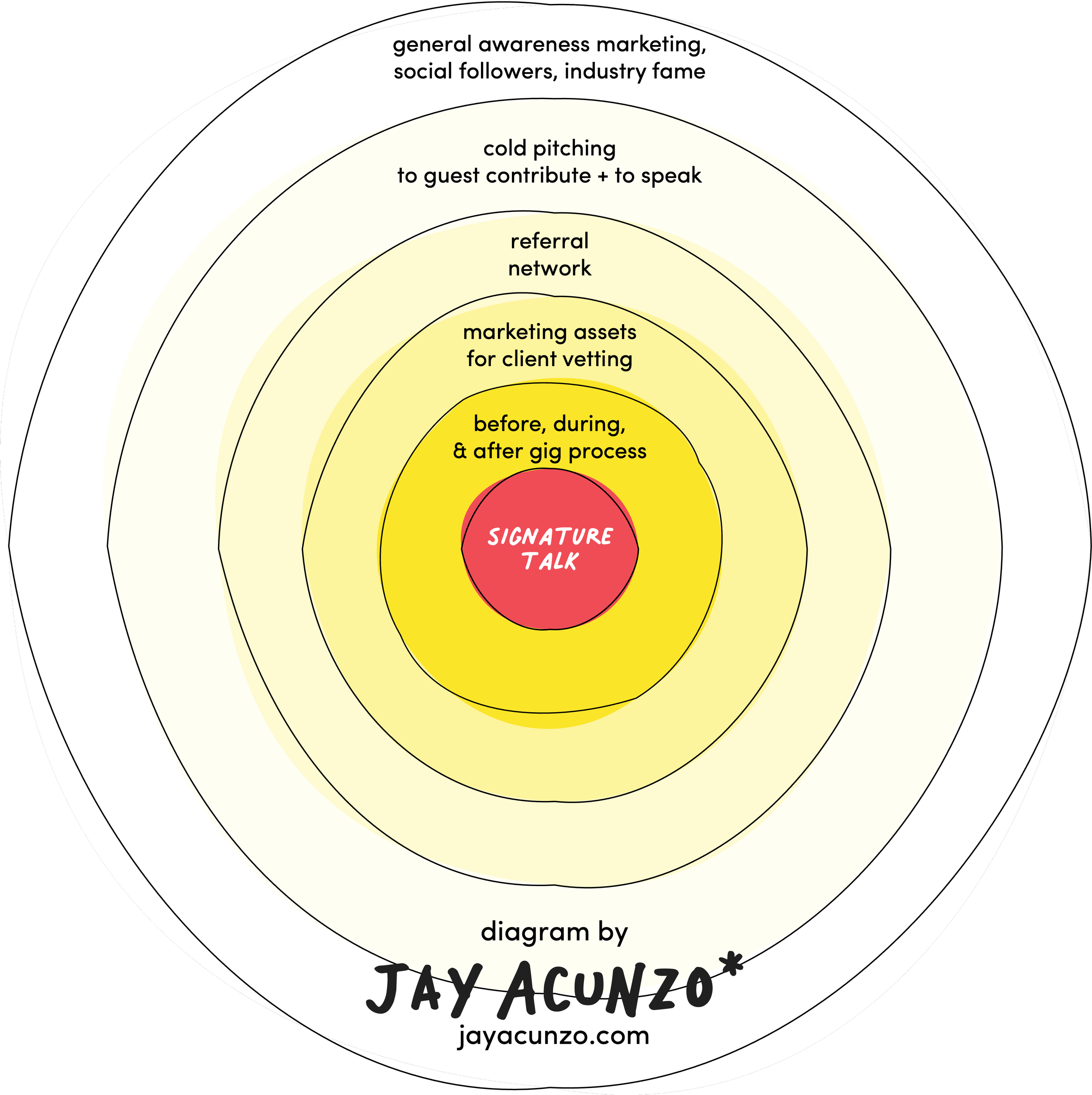
Start with what drives results. Stay close to the revenue engine. Improve that. Then move outward. The bullseye in the middle is the signature talk. One ring out is the before-during-after process. Then keep going. Each outer ring depends on the efficacy of what came before it. Chances are, if you're starting your speaking journey or wondering how to book more and better opportunities, you haven't yet nailed the bullseye.
When your speech isn't dialed in, pick your poison:
You’re forced to constantly cold-pitch, agonizing over deadlines and competitive speakers. You don’t get invited to speak nearly enough to earn from the stage, or at least make free speeches sustainable. (Here’s a hard truth about paid speaking: Breakouts pitch. Keynotes get invited.)
Your fees stay capped. Event organizers can't justify premium pricing for something that feels "pretty good." They need to see clear, undeniable transformation and tons of audience chatter about your speech in the room and around the event. If they can't articulate exactly what their audience will walk away with, they'll default to paying you like everyone else. Hence, you need your one signature speech pivoting off your distinct premise.
Your positioning stays fuzzy. Without a signature talk, you're “another expert on X” rather than “THE person who does Y.” You might be great, but you're not distinct. And in a world of infinite choice, distinct wins.
Every opportunity takes more friction. Instead of organizers quickly vetting you and giving you a fast pass to a contract, they're asking for more calls, more references, more assets. They take more convincing. Your marketing has to work harder because your product isn't doing the heavy lifting. This process can take hours of active communication and weeks or even months of time overall. Meanwhile, other speakers can give their 45-minute speech and earn multiple additional gigs.
But when the speech IS dialed in? Everything flips:
The speech becomes your most powerful sales asset. Organizers watch it and want that for their audience. Not because your website copy told them you’re great—because the thing itself proved it. Show, don’t tell. Show them what you’ve got.
Marketing becomes easier. The speech does the selling most notably, but all your materials now serve a stronger product, with higher-impact assets around your platform (video, testimonials, a speech description, etc.)
Premium fees become justified. Clear transformation = clear value = easier yes.
Compound returns kick in. Every time you kill it on stage, you generate the next opportunity (or several). Referrals multiply. People come inbound because their friend saw you speak last year. Or a friend of a friend who saw you speak last year has been quoting you to everyone they know. You’ve created an army of advocates—thanks to your speech.
Your reputation builds momentum, and things come easier. You stop chasing. You’re the one they seek.
The skills that got you here—your ability to craft compelling positioning, your instinct for conversion-focused messaging, your talent for selling before delivering—are the things which got you into the position of even asking me about keynote speaking in the first place.
But they're the wrong tools for the job at hand. We have to embrace what speaking actually is. This is not “a one-off talk.” And while it’s nice to hear nice things about your speech, they should also arrive with nice opportunities. (That’s even nicer.)
The bulk of your time, energy, and even budget should be invested into the things that sit closest to your revenue results. In the case of speaking, that’s your signature talk. The speech you consistently refine, customize, deliver, and reliably use to generate stage-side leads. The combination of your premise and IP, plus a smart and gripping structure, valuable and original content, and an undeniable performance.
In every other context, you market and sell before you deliver. Here, your absolute best leads—the key to sustainability and growth—experience everything before they decide to buy. You don’t need a different funnel. You need to play a different game. Play the game you’re actually in.
Stop trying to market an 80% speech. That's a 20% asset.
Speeches are sold backwards. If you're looking for more and better keynotes, just know:
"Good enough" isn't.
You can work with me 1:1 on your signature speech and speaking success, your premise development, and your overall platform of influence, or you can enroll in the next cohort of my public speaking accelerator.
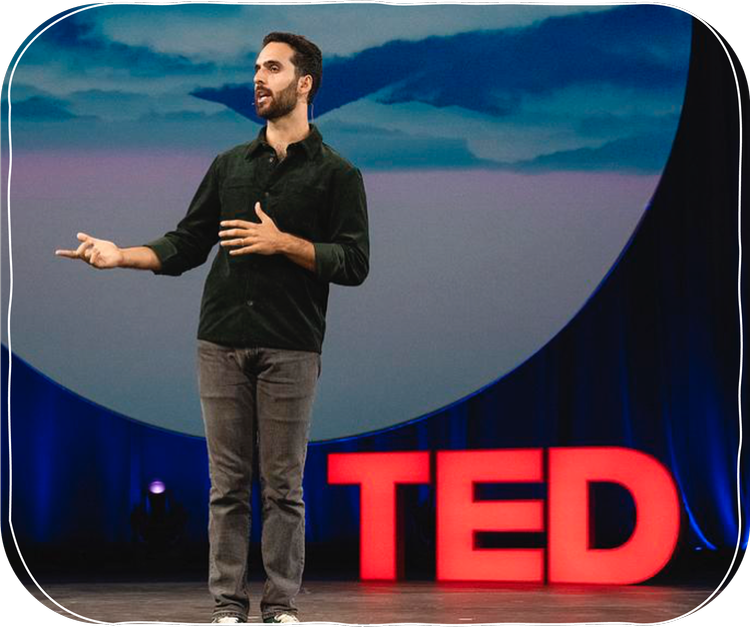
“Jay’s a practitioner, not a consultant. He’s got frameworks and lessons from years of speaking professionally and helping some of the best in the business, but his advice is not one-size-fits-all. Whether you’re prepping for your first keynote or you’ve given hundreds, Jay will make you better.”
—Simone Stolzoff (writer for The Atlantic & The New York Times; mainstage TED speaker; bestselling author of The Good Enough Job)