
Content ARCs: How to Stop Filling Feeds & Start Owning Your Ideas
There's a big gap between having a good idea and actually owning it publicly. Whenever I work with a client to develop their premise, we inevitably arrive at a sticking point: whether what we've developed ever gets deployed.
There are any number of ways your premise, i.e. your signature idea, can show up and benefit your platform:
Messaging
Public speaking
Guest appearances
Client diagnostics/engagements
But to make it smaller for a moment, let's focus on your content.
When you want to claim ownership of your ideas in the minds of the market, it's not enough to just aimlessly talk topics or share expertise. You have to actually explore your premise in public.
That's where things tend to fall apart, as old habits and existing commitments get in the way, plus the pressures of the modern marketing world (aka "checkbox marketing," as Brendan Hufford calls it).
Here's how to stop checking boxes and start exploring (and owning!) your premise in the minds of your ideal audience.
***
First, let's remember we're not creating content for content's sake. We're using content as a thinking tool and IP development system. When you consistently write or speak about your premise, you improve your thinking and language ... while also uncovering specific elements you can use everywhere, like frameworks, branded terms, stories, and more.
When I work with clients, I let them know: you won't check boxes or "fill feeds" anymore. Instead, you'll inform your thought leadership content by pursuing focused content “arcs”— multi-week explorations of a single theme, question, or concept pulled directly from your premise language.
Each arc follows the ARC methodology:
A = ASK the logical questions that flow from your last idea and/or from recurring language in your message
R = REFINE your thinking by creating multiple pieces of content exploring that question from different angles
C = CODIFY your ideas into ownable IP
Not all ARCs will lead to something as crystallized and memorable as a framework or branded term or signature story, but they always help you achieve some crucial outcomes, like improving your thinking, internalizing your own language, and building an audience along the way.
For example, I might look back at my message and realize, "Okay, if I keep telling folks to think resonance over reach—if THAT is my premise—then to actually message it well and own it publicly, I need to go explore that one idea (resonance) through content.”
So I'd follow this ARC:
A = ASKING the logical questions that flow from your last idea and/or from recurring language in your message
“I keep saying resonance. What does that word mean?”
“What is reach in relation to resonance? Opposites? Connected?”
“Why does it matter that we think resonance over reach anyway?”
R = REFINING your thinking by creating multiple pieces of content exploring that question from different angles
Posts and pieces I could create include 1 post to define resonance, 1 to explore how resonance works in the sciences (and what we can learn in our world of work), and 1 post pitting resonance vs. reach or showing their relationship.
These might be published initially as 3 different newsletter editions, which can then fuel social posts (smaller passages lifted from each piece, posted natively to LinkedIn’s feed, for example).
All of a sudden, instead of random acts of content, I have a coherent mini-journey to understand 1 idea, improve how I speak about, and cement my ownership of these themes in your mind. Lastly, we arrive at the end of the ARC:
C = CODIFYING your thinking into ownable IP (branded terms, frameworks, definitions, stories)
By the end of the ARC, I have my own definition of resonance that applies to my audience and my business: the energy to act your audience feels when your message aligns so closely with them, their thoughts, feelings, and abilities feel amplified. This is now part of my IP. I take it with me everywhere. It’s my expertise, packaged and communicated in repeatable ways to resonate.
While there are no signature frameworks from this ARC, maybe I leave with a signature story in the form of a metaphor I stumbled upon when opening one of my articles, which only popped to mind because I forced myself to write about resonance for multiple weeks in a row.
I might also leave this ARC with some signature “bits,” i.e. repeatable ways to explain my concepts, which are useful in talks, interviews, and writing. For instance, after defining resonance, I could communicate with this signature bit: “Think of it this way: If reach is how many see it, resonance is how much they care. No amount of reach guarantees they care, but if they don’t care, they don’t act. If they don’t act, we don’t see results. Even though we obsess over reach, it’s really resonance that drives results. Resonance leads to revenue."
The Strategy in Practice
Here is what I advise clients create their ARCs, and I offer my assistance on the first few to get them familiar.
Your mileage may vary based on your own ideas and expertise, and if you haven't tried to develop your own premise, maybe start here instead. That resource will help you develop what’s called a “narrative argument”—the long-form language you use to message your premise in a way that ensures others buy into it.
Again, start there if you haven’t done any premise development for yourself, or consider booking a discovery call to work with me. For now, here’s what I tell my clients…
First, read the narrative argument we developed together.
As you read it, save the ideas it sparks. Sometimes, these are direct references to the language itself (e.g. a paragraph you want to share elsewhere or explore in greater detail). Other times, something you read will lead to an entirely new idea for an advice post, a story, a framework, or something else. Save your ideas, all of which will now be "on-premise" for you.
Second, take another pass with greater intention: think of the logical questions that emerge from what you're reading.
These include questions YOU have, plus questions you anticipate getting from others. For example:
“I keep saying ‘teach the market how to buy you.’ What does that actually mean? What are the steps? What does it look like when done well vs. poorly?"
“I mention ‘The Category Conundrum’ as a concept. What exactly IS this? Can I define it crisply? What causes it? What are the symptoms? Is there a spectrum that leads to the moment the conundrum begins? Is that spectrum a possible framework of mine?”
“I say ‘innovative leaders’ vs. ‘commodified competitors.’ Do these terms work? Do they need better labels? What are the actual differences?”
For all my clients, this part of the exercise usually leads to a few common types of ideas for content, such as writing definitional posts for words you commonly repeat, anticipating objections from the audience, creating branded terms to name a problem or solution, sketching visual frameworks to explain the journey, and sharing stories or personal anecdotes/metaphors.
Third, create content to refine your thinking:
Over 1-2 weeks, write, record, and post multiple pieces exploring the questions and ideas from above. Articles published on your own site are useful for hyperlinking to them in future pieces and for sending links to prospects and clients directly. (I don't think about SEO at all, so I can't comment on that benefit.) Native social posts are useful for discoverability and audience engagement, but it's worth noting that early in your journey, you're writing to clarify things to yourself. The audience feedback loop is secondary, though it starts to matter more the longer you do this work.
On both your site and your social channels, cycle through all the possible pieces and posts relating to that single ARC, rooted in your initial questions and your "on-premise" ideas.
Finally, consider if anything is worth codifying into IP.
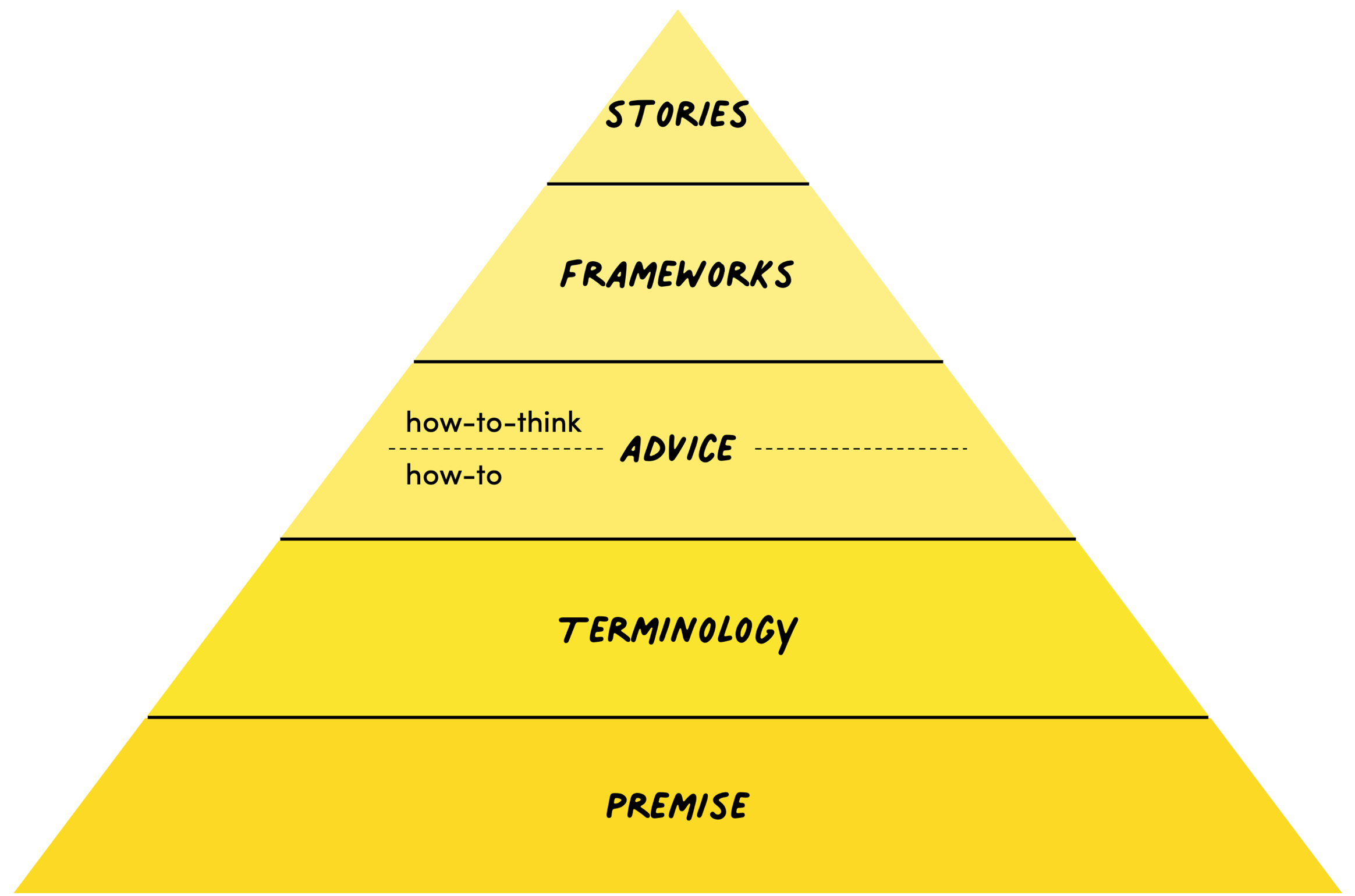
Consider the IP pyramid below. If you’ve had a breakthrough in something along the way, capture that as a reusable asset. What pieces of your latest content ARC should be packaged into IP?
...then move on to the next ARC!
Fair warning: discipline is required.
This only works if you focus, focus, focus. I don't want to hear that you're easily distracted as a person. I don't want to hear that you've got writer's block. You can pick a focus in theory, but clarity is built through communicating. We need to move forward with a stated intention. We start with focus, but we create clarity. We write and speak messily, even though it doesn’t feel great right now, because eventually, it will. Most people never experience that, because most people stray from their focus, which means they never achieve clarity, develop IP, or experience the VERY addicting feeling of momentum once ideas are well-developed and content flows effortlessly.
There is no substitute for the messy part. The only way around is through.
Another way to think about this: consider that if you had a train ticket for this Wednesday at 8am, you'd find a way to get on the train. You get on that train because you said you would and because it's 8am on Wednesday—not because you feel inspired.
Commit a couple of weeks to one arc (no jumping around topics randomly—focus, focus, focus)
Publish a few pieces per arc (you need multiple attempts to crack the code on your ideas)
Actually codify your thinking into IP at the end (don’t just “move on”—consider what needs to be developed into a reusable asset ... then publish that too!)
Source arcs from your premise language (not random ideas or "relevant keywords")
The temptation will be to say:
“Oh, I should talk about that latest trend or viral news." → NO. Stay on the arc, at least at first. You need evergreen IP, not random spikes of engagement that die and never generate real revenue. Later, you can press trendy things through your premise, because you've internalized your ideas to such a degree you can now color everything you see through the same lens.
“I have this other idea” → GOOD. Add it to a notebook for safekeeping. Pursue it later.
“This arc is getting repetitive” → GREAT. That’s when you and others both start to internalize your ideas.
Need a prescription for your output?
Try this:
Start with a longer-form piece to explore the big question or idea. Don’t judge it. Don’t worry if a lengthy article encompasses multiple ideas that you think might deserve their own pieces or even their own arcs later. Just create an earnest first attempt to understand or explore something. Write or speak from the heart.
Create 3-5 social posts over a 2-week span. Lift them from the initial long-form piece if it's easier, but ideally, these will be the natural follow-up questions or ideas from that first piece.
End with another longer-form piece as a kind of book-end to the arc. This can be a revision of the first piece, because now you actually understand your ideas better and bring sharper language to them, or it can be a kind of "so what?" or "what's next?" article. For instance, in an arc about resonance, I might begin by defining the term and end by finally and clearly explaining the relationship between resonance and reach—and of course, I’d revisit the definition once more in that final piece.
Or maybe I'll end the arc with a visual spectrum to explain something I was just exploring across all my content for two weeks. Or maybe I’ll flesh out a quick example into a more complete, signature story.
Regardless, I'll end with another longer-form piece to cap off the arc.
Again, that's just a prescription for your next arc (long-form piece, a few short-form posts, another long-form piece), but make it your own!
***
Focus is a strategic advantage. Writing is thinking. Content is both distribution for proven ideas and a means to work out even stronger thoughts. We hear these ideas often, but when it comes to executing against them, we often trip or fall.
Remember to think and publish in ARCs: ASK the logical questions based on previous content, existing messaging, or your distinct, ownable premise. REFINE your ideas through active exploration and creation. It's the best way to find clarity and sharpen your words. Finally, CODIFY the strongest bits and ideas, as you package your expertise into reusable elements of your thought leadership: branded terms, teachable methods and frameworks, signature stories, and more.
In 3-6 months, you'll have developed, validated, and internalized your premise, built significant IP, and helped orient your audience around certain key themes, all while winning passionate fans along the way. Like you, these fans will emerge with better, more memorable and repeatable language that they can use to distribute your message.
No more guessing. No more checking boxes.
Stop filling feeds. Start owning your ideas.