Experts: Before You Can Increase Revenue or Impact, Stop Making This Mistake
A few years ago, I was having coffee at a conference with a friend and fellow speaker, when someone approached with a question.
"Jay!" she said. (A fine opening, I thought. For that, dear reader, is indeed my name.) "I saw you speak about premise development! I've been working on finding my unique premise for my business. Can I share mine with you?!"
I loooove conversations like this. It's fine enough when folks ask about theory or trends or "what should I..." type questions, but when someone asks me about something I actually created or shares with me something they've made? It warms the cockles of my heart.
I eagerly consented, and she pulled out her laptop, navigated to her website, and showed me her home page. It's there I saw it. It was sitting on the most gorgeously designed site, adorned with eye-catching animations and colorful flourishes, peppered with social media icons and client logos.
"So that's the idea," she said. She jabbed her finger at the website copy. "I'm really proud of it!"
To hide her identity and also because it sounded fun, I asked Claude to step in here. You'll see why immediately:
"Imagine you are a marketing consultant focused on social media, creativity, and brand building. What would be the most generic-sounding copy you could write on the top of your website that YOU believe is super original but isn't?"
(Hey, when you need generic writing, you turn to the best.)
Here's what I got back:
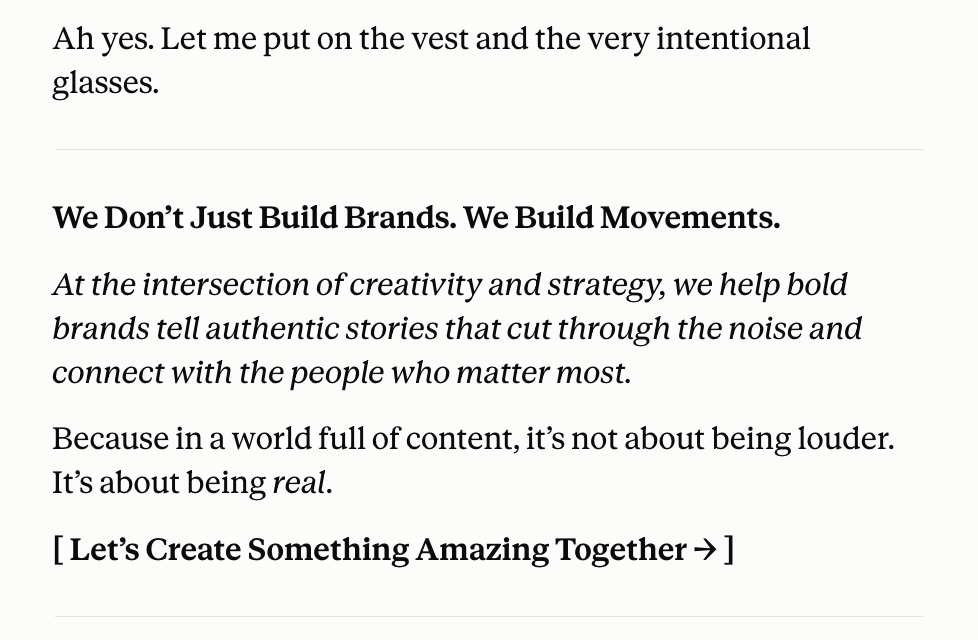
You know what the scary part really is here, dear reader? I'm trying to hide this person's identity, but if she saw this, she'd immediately see herself in that copy. Yikes!
Thus, we've done with AI what far too many others are doing too: summiting Mount Mediocre and planting a flag for fine.
Stay tuned for my $29 course where you can "steal" my "secret" prompts.
(brb, gotta go shower that sentence off me...)
Over coffee, I went easy on the person. It's her idea, after all. Nobody likes to be told their baby is ugly—or even simply "fine." Even if it's precisely what we need to hear (about the idea, not the baby, you monster). I couldn't attack her idea, so instead, I attacked the trend, the tendency, the conventional wisdom:
As experts, we routinely make the same mistake:
We confuse beautiful packaging, creative branding, and snappy copywriting for how OWNABLE an idea really is.
We give our idea a branded name (because you simply must create a category, haven't you heard?). Maybe we add a little trademark(TM) next to it, or maybe an acronym that spells something clever (“The NOPE Approach”). Then we house it all on a website similar to the one I saw that day.
It all looks different. But is it actually different? (NOPE.)
Turns out there’s a very big gap between something looking different and something actually being different—and being truly yours.
You may have seen my notes about building an Idea Laboratory to help you develop a truly great premise for yourself, your thought leadership, and your business. To do so, I've partnered with my friend and one of the best in the world at developing stronger, more sellable ideas with soul, Andrew Davis. One of the first things we agreed on when designing this program and agreeing to partner was this line we wrote down:
We are less interested in how you've packaged your idea and more interested in the thinking behind it.
Because that's where original ideas come from. It’s right there in the word:
Original. Origin. Did it truly originate with you?
If so, it could be an ownable idea.
If not, it’s a commodity concept in nicer clothes.
Ask yourself…
What do you see about the problem that others don't?
What conventional wisdom do you question or trends do you hate?
What does everyone else accept that makes you say, "Wait a second..."?
Because an ownable idea isn't a new name for familiar expertise. It's a different way of seeing a real problem.
It's unique enough that when someone hears it, they think: "Holy smokes, I never thought about it that way."
That's what we're looking for: not just an acceptable thing you can put in the blank, but something you can actually own.
How do you do this work? A simple framework + classic example
🛑 Before you spend any more time or money on those 47 marketing things you're convinced you need to do, ask yourself:
“How ownable is the idea fueling all of this work?”
Here's one way to find out: complete the following prompt:
"I talk about ___.
Unlike others who talk about ___, only I show people ___.”
Really, actually pause here and write it down. What comes to mind in messy fashion, without judgment? What might you say if you gave yourself 10 seconds to improve the mess to something still-messy-but-10-seconds-more-thoughtful?
The key is the "only I show..." part. What did you write there?
Most of us can put something there:
Only I show... "leaders how to build cultures which actually support people."
Only I show... "people how to use AI without losing the human side of work."
Only I show... "companies how to navigate change with confidence."
Only I show... "people to stop hiding and better market themselves."
Those are all good ideas. Important ideas too, perhaps. But are they OWNABLE?
That's a totally different question.
For years, Simon Sinek has had an ownable idea. You can't throw a stone at a conference without hitting someone who is saying out loud, "Find your why." That's all thanks to Simon's book, Start with Why. But before the book, before the speaking career, before the acclaim, it was just an idea he had for solving a problem he hated.
How might he have filled in those blanks?
Maybe he’d start here:
Only I show audiences how to communicate in ways that inspire people
Useful. Important. And something a thousand experts could say.
But in the talk that launched his idea to more people, he didn’t just propose answers.
He asked questions:
Why is Apple so innovative when it has access to basically the same talent, the same agencies, the same consultants, the same media as everyone else?
Why did Martin Luther King, Jr. lead the Civil Rights Movement when he wasn't the only great orator (or person) suffering under segregation?
Why did the Wright Brothers achieve powered flight when other teams were better funded and better qualified?
Where most people start with known problems (“people want to solve or do THIS…”) and their existing expertise for solving it (“here’s what I can teach you about that…”), Simon investigated underneath the obvious problems, and he decided to answer a more interesting series of questions:
🤔 Why do some leaders inspire and others don't?
😮 Why do organizations with access to the same basic ingredients get dramatically different results?
🤨 What THE HECK is going on here?
He investigated, noticed a pattern, and then codified what he found into the Golden Circle, a series of 3 radiating circles like a bullseye diagram, with WHY in the middle, then HOW, then WHAT. (BTW, Simon never trademarked the Golden Circle. He seems to realize what we all need to embrace: true idea ownership is about owning an idea in their minds, not in a legal database.)
Simon didn't start by saying, "I need a proprietary framework…" The framework came after the investigating. It came after deeper thinking and publicly communicating. So did the book, the speech, the website, the social media presence—the business and the impact. It all followed the idea.
That's what Andrew Davis and I mean when we say we're not interested in a clever way to package what you already know. We're interested in helping you find, clarify, and distribute something underneath it all: the meaningful problem actually worth solving + your unique idea for solving it.
Because the problem everyone else is talking about is probably not THE problem. It's most likely a symptom.
And the idea you’re quick to share is probably not THE solution they need. It’s most likely generic expertise. Foundational and useful but found everywhere. Not very ownable. Not enough to have an impact or see a return.
Don't make the classic expert mistake.
The same mistake I saw on that consultant's beautiful website years ago. Don't wrap a "fine" idea in nicer clothes.
How do you SEE your topic? Said better, how do YOU see your topic? That's where originality starts. That's the path to something more insightful and more ownable. Articulate and own that. Share that publicly to validate it. Investigate by asking questions and finding the deeper problem others need solved—and your premise for how to solve it differently and better.
And if you're ready, let's build that idea together in the Idea Laboratory. The program is built for doing things, not watching things, as you work on YOUR thinking and YOUR marketing, rather than just observing ours. Guided by live coaching with me and Drew. See you in the Idea Lab!
This program has just 5 seats available as of this writing, 10/19.
We're closing enrollment at 30 seats. We expect to sell out soon.