
You Keep Saying "Add Value." I Don't Think It Means What You Think It Means.
A version of this story appeared in How to Resonate, my newsletter that helps you differentiate easier and resonate deeper. Get your own copy sent each week to your inbox.
In a recent essay as part of this series on high-impact ideas, we talked about the two archetypical ways we communicate when we want to resonate with others. I called this your “resonance tendency.”
You can be an evangelist (that's my natural tendency) who prioritizes the originality of your ideas, or you can be an analyst, who prioritizes something else:
Value.
But "value" is not a fixed trait. It's a spectrum. Some things have value which fades. Some things have value which lasts. Some forms of value feel transactional (when you need it, you need it—but then you're done with it) while others feel transformational.
This is why the advice to the classic content marketing advice to "add value" is so ... flimsy? Misleading? At very least, it's insufficient.
If you're trying to resonate by adding value, you need to recognize the three different kinds. If you're a natural analyst in the way you communicate, this is even more important, because value is your calling card.
Unfortunately, most of us get stuck on the lesser two types of value. Our ideas anchor to those. Our content as well. That's a hard way to resonate with others these days.
Let's start at the bottom of the value spectrum, then work our way up to understand where we should go. Oh, and to truly understand this concept of "value," we’ll also need to touch on two other things: the map metaphor and then my favorite part of this, the magic trick.
The Value Spectrum
At the bottom is informational value. Your idea and your content both provide others information they need (or you assume they need). This is the least valuable way to communicate today.
Informational content sounds like “what is AI?” and “here is my pricing” and “the six fastest-growing brands in our space.” Sometimes this kind of content is foundational or useful. (When you want to master something, it helps to know the definition. When you want to know someone’s pricing, you really do need that information.)
Information can also be downright fun too. Trivia is information. Revealing the six fastest growing brands in an industry is information. Also, fun fact: capybara's sometimes eat their own poop. ("Fun" is a word my kids used when excitedly telling me this.) Okay, genuinely fun fact: if you want a talk to be more memorable, your opener and closer carry the most weight. Nail those. This is due to the primacy and recency effects.
Cool information, right?
Unfortunately, many of us are stuck there, at the bottom of the value spectrum, sharing information. With most information, and with its close kin (instruction; one step higher on the spectrum), people absorb it, then move on. This is why we feel stuck on the content marketing hamster wheel most days. We keep shoveling more and more content onto the internet, and sure, sometimes, they consume it. But they aren't transformed, aren't deeply served, aren't prone to sticking around and building a relationship with them, so we have to hold up the next bit of information. "How about this fact? What about this one? Can I interest you in five facts about your field? No? How about 10 steps to success? Ah ha! That's working! Oh wait, you're drifting towards the infinite sources of instructional value out there? Guess I'll run harder on the hamster wheel..."
Informational ideas.
Instruction ideas.
The first offers the least value. The second offers some. Both are highly commodified today. Created by everyone and their mother (sometimes literally).
We need to evolve this notion of "adding value" by embracing a simple but hard truth:
If we want to add more value to others, we need to make our ideas more insightful.
That's the top of the value spectrum. Insightful content.
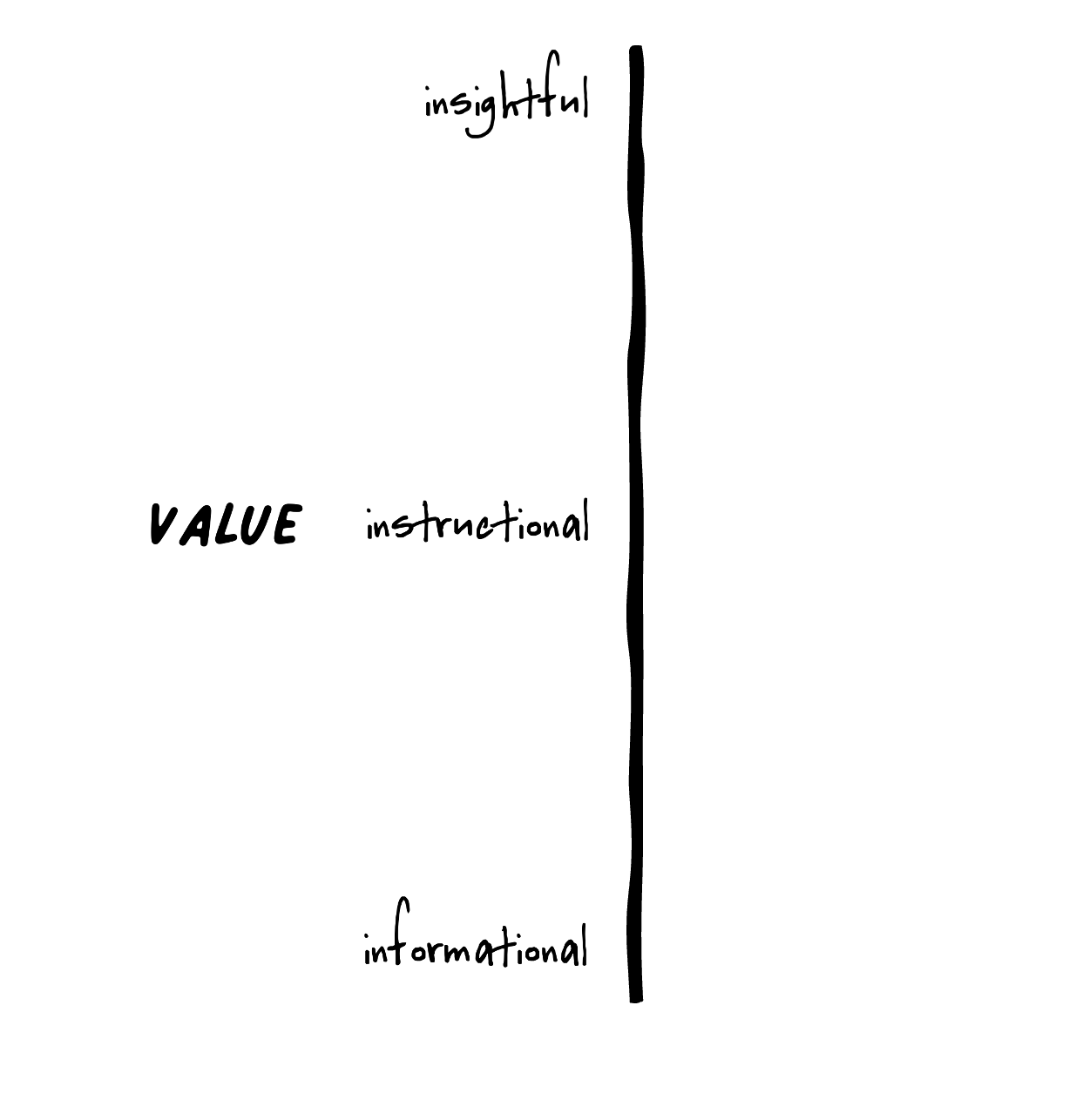
Not only are insights themselves more valuable (we'll get to that), they make any information and instructions you share even more valuable, because they are colored by your deeper insights.
Sharing something insightful, not just informational or instructional, makes your ideas much more rare, precious, and powerful, both for you to share and others to receive.
If informational value sounds like “What is AI?” then insightful content sounds like, “Why use AI in this job for this task, given our goals and our resource constraints?” An insight is not simply revealing the six fastest-growing brands in our space. It’s more about analyzing why they're growing so quickly and what we can learn. An established fact is informational. New research helping us update the facts? Now that's insightful.
Looking at instructional, the middle tier: a best practice is instructional, but a critical thinker or visionary voice who challenges best practices can be more insightful. That person shows us why our current information is insufficient and recommended instructions are broken. They reveal to us a deeper problem we must solve, which right now we aren't seeing, let alone solving. That person is insightful. They don't hand us a map ("This is North Anerica!") or even instructions ("Follow the red line to the X!"). Instead, they hand us a compass. We can get our bearings in any scenario, find true North, and figure things out from there.
It's wildly empowering to receive an insight. Because they're wildly valuable compared to the rest.
If you want to make your ideas more valuable, you need deeper insights. Not more information, not even more years of experience. You need to find something deeper, something they're missing, something that changes how they think and how they see things.
Information updates people. Insights empower them. If we want to have a greater impact, we need to remember:
We're in the business of empowering others.
*
At the beginning of this piece, I said we'd discuss the three types of value. (Check!) I also talked about using a map metaphor. (Done!) But then I mentioned the magic trick. Watch closely now...
The magic an insight gives all your work
There's this really fun (or lame, or both) movie called Free Guy starring Ryan Reynolds. In it, he plays Guy, a background character in a video game. When a human enters the game, their character is wearing a pair of goggles, which allows them to see all the parts of the game: floating power-ups, hidden tools, secret paths, important challenges and checkpoints.
When you've found a deeper insight, using it is like using a pair of those goggles. In the movie, when Guy puts on a pair, his mind is blown. Suddenly he sees a world he thought he knew in totally different way, and he personally becomes capable of things he'd never dreamed of doing before. Not because he couldn't do it. Because he couldn't see it.
When you arrive at a deeper insight about something, or someone hands you one, it's like you suddenly make sense of the entire world through that lens. Once I committed to exploring this concept of "resonance" and talking about my premise, resonance over reach, I had a distinct lens through which I could see and teach everything. When I want to make sense of something others also talk about, I might tell myself, "How can I 'resonance over reach' this?"
It's clunky to say, but it's really effective. It makes everything I do more insightful, not by draping nicer clothes over basic forms of value, but by "bridging" from the insight to the information or instruction, which elevates those things too.
For example, I've noticed for years now that people who share helpful advice seem to break into two camps (setting aside the hucksters and focusing on people with actual expertise for a moment):
They turn their expertise into IP: an original premise and all the thinking built on top, which allows them to explore, distribute, own, and monetize their expertise in memorable, repeatable ways.
Or they sensationalize their expertise with clickbait.
A ton of people get visible by doing #2 thanks to social media algorithms, and it frustrates the hell out of me. So one day, I stopped to wonder why. Why the heck does a post which is meant to be pure and helpful and valuable suddenly feel so ... aggressive?
I decided to 'resonance over reach' it. I pressed it through the lens of my idea. How can I make sense of this using my lens? Out came this piece in 2025, which I posted on LinkedIn. I got good engagement and discussion in the comments, and I feel good about what I'd written too. That led me to evolve my thinking and turn it into this video this year, because the initial resonance justified the added investment.
That's the magic trick.
When you arrive at a deeper insight, it doesn't just deepen your resonance when you speak to the insight directly. It makes you more resonant when you speak about ... anything. It enhances the efficacy of your entire platform, NOT because you found a clever hack or trick, but because you pressed it through your lens. You found a pair of "magic goggles," and not only does it change how you see things, you can hand it to others and help them see it too.
What a beautiful way to build an audience, a platform, a business.
Information updates people. Instructions direct them. Insights empower them. The world is overflowing with the first two. What the world craves from us (or, said better, what your audience craves from you) is something more insightful. More empowering.
More valuable.
*
Next time, I'll talk about the other trait of high-impact ideas: originality. This trait also runs on a spectrum of three things.
The impact of your ideas is proportional to both your value and your originality. In this series, I'm helping you increase the impact of your ideas, so you don't need to worry about the volume of your marketing. More next week!