If You Want to Be More Original, I Have Good News and Bad News
A version of this appeared in How to Resonate, my weekly newsletter, helping you compete on the impact of your ideas, not the volume of your marketing. Subscribe here. I think you’ll love it!
***
Dispatches from the Week:
Hi, my friend! I'm riding high after about public speaking at B2B Forum and seeing old friends visiting my home area. I also realized something kind of wild about this year's event, a conference of 800 B2B marketers and business leaders:
I was privileged to help eight of the speakers who took the stage this week.
This is utterly wild to me. To varying degrees, my career has been defined by public speaking and storytelling in one form or another, and yet there was a moment where it felt all was lost and I would be forced to accept some kind of droning corporate marketing role at a business that sold the color beige to customers who said words like synergy.
But here I am, somehow on the other side of a rough patch that sat between my own speaking business achieving scale and now my advisory business having grown beyond anything I've ever built before. I'm amazed, really, and I'm grateful for all the support flowing from this newsletter week to week. I wouldn't be standing here without you. Or sitting. (I'm sort of hunched over my breakfast bar enjoying a dark roast in a bright mug as I sprinkle a little dill and parsley onto my omelette.)
Thank you!
If you'd been planning to work with me soon, please inquire about availability now. My next client opening is in January, and I'm booking out into 2027.
💛
I'd also remind you that you can watch me in-action on my YouTube channel, working with others. The latest features the very beginning of the premise development process for Dr. Tom Nicholson.
Today's Essay:
I've been writing a series about how to compete on the impact of your ideas, NOT the volume of your marketing. How can you resonate so deeply, you become their favorite?
We have to put resonance over reach. This is the series where I'm teaching you how to do that.
Essay #1 in the series was about a small pita shop in Denmark with a big marketing lesson.
Essay #2 established the 2 natural ways we try to resonate with others. Which is yours?
Essay #3 looked harder at one of the resonance tendencies (the analyst) and the 3 degrees of value you can provide.
Today, in essay #4, we'll look at the other resonance tendency (the evangelist) and the 3 degrees of originality.
***
In my last two essays, we talked about the first of two different archetypical ways we attempt to resonate with others, according to our natural communication tendencies. You might be an analyst who often focuses on grounded, practical ideas and believes value is the best way to resonate, or you might be an evangelist who often focuses on unique, memorable ideas and believes originality is the best way to resonate.
Obviously, these two archetypes are not mutually exclusive. We all have elements of both. But we do have tendencies, and understanding yours will help you turn tendencies into strengths and strengths into superpowers.
Today, we need to talk about the three degrees of originality. These matter to us all, but they're mission-critical for an evangelist to understand, since originality is their calling card.
Personally, I'm an evangelist. Maybe you are too.
✅ The evangelist likes their ideas and content to appear creative, thanks to clever angles, personal perspective, and originality.
💛 The evangelist earns trust via stories, inspiration, humor, charm, and personal connection.
😡 The evangelist is easily frustrated by people showing a lack of empathy or forgetting the “humanity” of it all.
An easy way to understand Evangelist Jay circa 2013 is that I'd be very fired up to present my ideas in a talk or pitch, share several stories and metaphors to make those ideas come to life, get a few hearty laughs in the room, and then slap a number on it because you're supposed to be "data-driven" in business. Maybe I'd even have something more insightful to say than "talk to your customers" or "create better content," but I doubt it.
The experience would be great for others, and then nothing would happen afterwards.
I kept making the classic mistake evangelists make—or anyone trying to be original. Remember the "bad news" I mentioned? The very thing that starts us towards originality often stops us before we can go all the way and maximize our impact. Put bluntly:
We often get too personally invested in our own ideas to actually produce something truly original.
Because to do this work (drive a result, have an impact, change the world), the ideas can't just feel personal to you. They must actually be ownable by you. They must feel original to others, not just yourself.
Those are the three degrees of originality. An idea can be general, personal, or ownable.
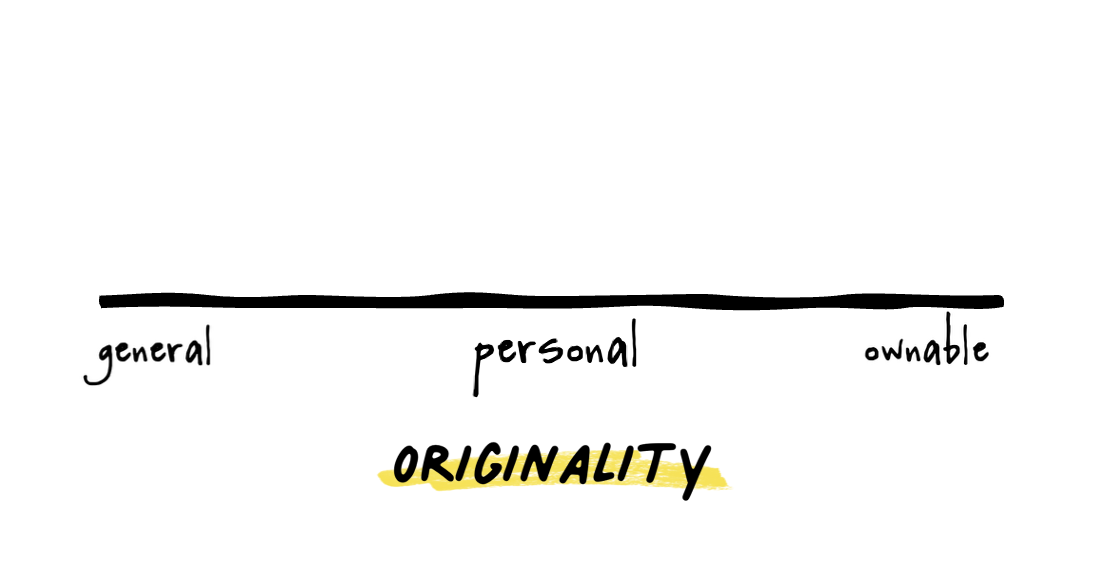
A general idea is easily recognizable. It looks and sounds like everyone else. Anyone in your space could have said or done that. It's the most commodified sort of thinking today. When an entrepreneur decides they need to launch a podcast, for instance, and they plan to interview the biggest names in their field, that's a general idea for a podcast.
Then, they step towards a dangerous middle ground. A general idea starts to feel personal to them. I say "dangerous" because, while there's nothing wrong with having a personal passion for an idea or tying your personal brand to an idea or using your own personal experiences to fuel an idea, you stop short of what the idea should be. Because sooner or later, your own excitement about the concept has to give way to others feeling excited too. Not just any old "others," either, but folks who aren't personally connected to you!
I have to hide my facepalm reactions when a speaker excitedly tells me about their next book. They tell me they've been working on it really since leaving their corporate job, because they want to reflect on their experience there, and they have SO much to say and teach. Maybe! So what's the idea? They then tell me about the most generic-sounding advice or concept. But, but, but, Jay, before you protest that this is a generic idea with a touch more emotional charge, just know: everyone else is also really excited about this book concept too.
Who are these "everyone elses," you might wonder?
Friends and colleagues.
People who saw the author speak and said nice things.
Le Sigh...
Your friends and colleagues aren't going to say to your face, the idea stinks, your baby is ugly. And the only people who approach after a talk say nice things. Nobody walks up to a speaker to say, "You know, before you got into your signature story around minute 5, I was pretty bored and confused by your central premise."
And look, doing creative things is hard. Being original is difficult. But we make it more difficult when we conflate our own personal investment in an idea with that idea's ability to have an impact.
It might start with our personal passions, brands, and experiences. But it can't end there.
This is the same advice I give to speakers who swear they have a story to tell on stage. "I want to tell others my story." I love that! That should help give them more energy and greater conviction to do the work of developing their ideas further, but too often, it causes them to stop. "I succeeded. I persevered. I did something awesome." And that can be part of your talk and your platform. And that can lead to deeper questions and an investigative journey to solve meaningful problems for others and bring them new ways of thinking. You can definitely "tell my story," but it can only be part of it. Not all of it.
It can be the door. It can't be the whole house.
As an evangelist, the danger is mistaking your own excitement for theirs.
But there's nuance here. Of course there is.
We don't just drop our conviction and our own personal ties or passions and say anything that "works." As comedian Mike Paramore once said on a stage before I spoke at an event, "People think because I'm a comedian, my job is to make you laugh. No. My job is to find the people who think I'm funny."
Your job is to find the people who love your ideas. However, that won't work if they've found similar ideas from countless other sources. You can find the right people, but if you aren't truly bringing them something differentiated, then they're adding you to a mental spreadsheet (or a real one) of similar voices ... if they even glance at you at all.
So where does that leave us? We need to push beyond ideas-made-personal and build our ideas to be something else.
Ownable.
The logical next step (and the end of the originality spectrum we aspire to move towards) is to turn an idea from personal to us to ownable by us.
I am personally invested in making you an exceptional speaker. I want you to unleash your voice, to resonate deeper, to bring stronger ideas into the world as an expert, because experts often get stuck shoving walls of smarts at others, and it's ineffective. I want to help turn your mountain of material into one distinctive premise, plus all your IP and stories, capable of increasing your impact, everywhere you go. And while I hope you enjoyed those sentences, if I'm going to succeed in building my business and having a positive impact, I need to embrace:
Others can write them. Others would say that. Others have said that.
I don't need to say things nobody else has said, but gosh darn it, I do need to make my ideas more ownable. Very well.
Don't market more. Matter more.
Think resonance over reach.
Don't be the best. Be their favorite.
Those sentences are owned by me. I say them, I own them, I repeat them.
Or maybe we zoom into public speaking as a topic. I want to speak about speaking more often, just as I did this week in Boston. Very well! How might I pitch my ideas to be more than an emotional plea to care about speaking or excel on stage? Others can say that. Others would say that. Others have said that.
I need a different approach to sharpen my ideas and evolve them from personal to ownable. For that, I use my XY Premise Pitch.
The XY Premise Pitch
In this pitch, X is your topic. That's what you talk about. Others talk about similar topics. Your topic isn't ownable. That's why we need the Y. That's your premise. It's not your topic so much as how you see your topic. It's what you plan to argue for, reveal to others, and move them towards. It's the lens through which you press everything. It's the big idea you explore and own.
"Your body is not a temple. It's an amusement park. Enjoy the ride." That's an original, ownable idea from Anthony Bourdain.
"People don't buy what you do. They buy why you do it." Simon Sinek.
"We need to stop saying 'representation.' Real change requires recognition, more than representation." Chloé Nwangwau.
Those are insightful, ownable premises for each of them. So, let's use the XY premise pitch and see what we can find, for you and for me. The pitch sounds like this:
I speak about [X]. Unlike others who speak about [X], only I show audiences [Y].
A few examples, then I will try to evolve MY ideas about speaking from something personal to something a bit more ownable.
"I speak about how leaders can avoid burnout. Unlike others who speak about how leaders can avoid burnout, only I show audiences it's not the workload burning out managers today. It's the thoughtload." That's author and speaker Liane Davey.
"I speak about marketing. Unlike others who speak about marketing, only I show audiences how to find the right moments to move more slowly. Because when speed becomes cheap, judgment carries a premium." Ann Handley
"I speak about small business growth. Unlike others who speak about small business growth, only I show audiences that you need a sequence, not a strategy. Knowing the next right move matters more than knowing all the moves." Michelle Warner
Now let's train this framework onto my ideas about speaking. In my speaking about speaking (I'll just keep saying that until your eyes twitch), I talk about how to open strong and end stronger. I talk about structuring the talk. I talk about premise development. I make the case that you should embrace speaking more fully today, both the skillset which follows you everywhere and the process of creating and delivering actual presentations, because it's AI-proof, it's where the world is heading (back in-person; woohoo!)
I speak about speaking. Unlike others who speak about speaking, only I show audiences that awesome speakers aren't more experienced, famous, or charming than you. They are better at breaking betters. Because the speech is meant to do 1 job: create a before-and-after moment with others.
This not only helps inform an actual pitch or brief description of my talk, it helps ME build the talk. Everything I do inside the session is colored by that premise, from the examples I use, the framework I teach, even the metaphors and jokes built into my opener and the story I use to close. Because I've started the process of turning a personal idea into an ownable one, not only is marketing and selling the idea made easier, but each and every one of my choices feels clearer too.
***
In our attempts to create and share more original ideas, it's tempting to conflate something that's personal to us with something that's ownable by us. They might be the same, but we have to work hard to validate that. We also have to eat some humble pie when we realize we were wrong, and mostly, in this line of work, you're wrong. We often think we've found something we can own, but doing any research at all would suggest otherwise.
Sometimes, that research happens with a quick search online. (I was talking to a speaker last month who swore by their talk's premise. Swore it was ownable. On the call, I searched for the exact phrase they use to describe their ideas and brand their talk. The exact phrase THEY use was also the exact title of five different TEDx talks, three books, and countless blog posts. It took Google milliseconds to show this speaker they had work to do. Again, sometimes, some online research is all you need.
Other times, you need to share your ideas with folks outside your network and validate that you're resonating with them. I value my friends who like to support me. I value event attendees who say nice things about me. But I don't let their compliments prevent me from doing the hard and humbling work of actually proving out my ideas. You can't validate your thinking in a 20-page PDF outlining all your thinking or a Google Doc with your personal manifesto or a cheerleading session with folks who only arrive to praise you. The idea has to enter the boxing ring and get beat up a little bit. If it's still standing after, congrats, you've got something. The more likely scenario is, you need to hit the gym after the bout and make the idea stronger.
Don't drop your conviction. Don't drop your excitement. Remain personally passionate about your ideas, please. But use that as fuel for the journey to develop your idea further, to make your idea ownable.
Don't mistake your feelings for the finish line.
Most ideas make you a relevant option. Ownable ideas make you the preferred pick. To increase your originality, you don't need more budget or hype, more emotional pleading for others to care.
You need an idea you own.