
Turning ideas into content into I.P.
CONTENT STRATEGY: Think in “ARCs”
We're not creating content for content's sake. We're using content as a thinking tool and IP development system.
You'll inform your thought leadership content by pursuing focused content “arcs”—multi-week explorations of a single theme, question, or concept pulled directly from your premise language.
Each arc follows the ARC methodology:
A = ASK the logical questions that flow from your last idea and/or from recurring language in your message
R = REFINE your thinking by creating multiple pieces of content exploring that question from different angles
C = CODIFY your ideas into ownable IP (branded terms/definitions, frameworks, stories, etc.).
Not all ARCs will lead to something as crystallized and memorable as a framework or branded term, but they always help you achieve some crucial outcomes, including improving your thinking, internalizing your own language, and building an audience along the way.
-
For example, Jay might have a long-form argument about why you should embrace his premise, “think resonance over reach.” His next content ARC might then look like this:
A = ASKING the logical questions that flow from your last idea and/or from recurring language in your message
“I keep saying resonance. What does that word mean?”
“What is reach in relation to resonance? Opposites? Connected?”
“Why does it matter that we think resonance over reach anyway?”
R = REFINING your thinking by creating multiple pieces of content exploring that question from different angles
Taking just the first question above, posts and pieces Jay could create include 1 post to define resonance, 1 to explore how resonance works in the sciences (and what we can learn in our world), and 1 post pitting resonance vs. reach.
These might be published initially as 3 different newsletter editions, which can then fuel social posts (smaller passages lifted from each piece, posted natively to LinkedIn’s feed, for example).
C = CODIFYING your thinking into ownable IP (branded terms, frameworks, definitions, stories)
By the end of the ARC, Jay has his own definition of resonance that applies to his audience and business: the energy to act your audience feels when your message aligns so closely with them, their thoughts, feelings, and abilities feel amplified.
He also leaves this ARC with some signature “bits,” i.e. repeatable ways to explain his concepts, which are useful in talks, interviews, and writing (e.g. he’d follow up the definition of resonance by saying, “We all need our audiences to act. That’s how we see results. Not by reaching others, but by resonating so they actually care about us and our ideas. If they don’t care, they don’t act. If they don’t act, we don’t see results. As much as we obsess over reach, it’s actually resonance that drives results. Resonance leads to revenue.”
THE STRATEGY IN PRACTICE
Start with your premise argument language.
As you read it, save the questions or ideas it sparks. Sometimes these are a direct reference to the language (i.e. lifting passages from the language that needs further exploration or merely a post to publicly distribute/own it). Other times, new ideas and questions will come to mind.
As you read the language, ask the logical questions that emerge. These are questions you have +questions you anticipate getting from others
e.g. "I keep saying 'teach the market how to buy you.' What does that actually mean? What are the steps? What does it look like when done well vs. poorly?
e.g. “I mention 'The Category Conundrum' as a concept. What exactly IS this? Can I define it crisply? What causes it? What are the symptoms? Is there a spectrum that leads to the moment the conundrum begins? Is that spectrum a possible framework of mine?”
e.g. "I say 'innovative leaders' vs. 'commodified competitors.' Do these terms work? Do they need better labels? What are the actual differences?"
Some Common ideas you’ll likely think about and pursue in content:
The words you repeat and must define for others and for your ownership of them
Objections you anticipate others will have to your words
Branded terms you coin to help name the problem and/or solution
Visual frameworks to explain the journey
Signature stories/examples you start to develop
3. Next, Create content to refine your thinking: Over 1-2 weeks, you write & post multiple pieces exploring the questions + ideas from above:
Article on your own site (for hyperlinking/sending to others/referencing in the future, if the piece ends up a pillar piece)
Social post (e.g. LinkedIn post, IG reel, etc.)
Cycle through pieces which address a question + examples + misconceptions + what to do about the idea, etc. (Consider the 1 question or idea from all angles and what the audience will need from you eventually)
4. Codify anything powerful into reusable i.p.
Consider the IP pyramid. If you’ve had a breakthrough in something along the way, what elements can you create to help you teach + own the idea?
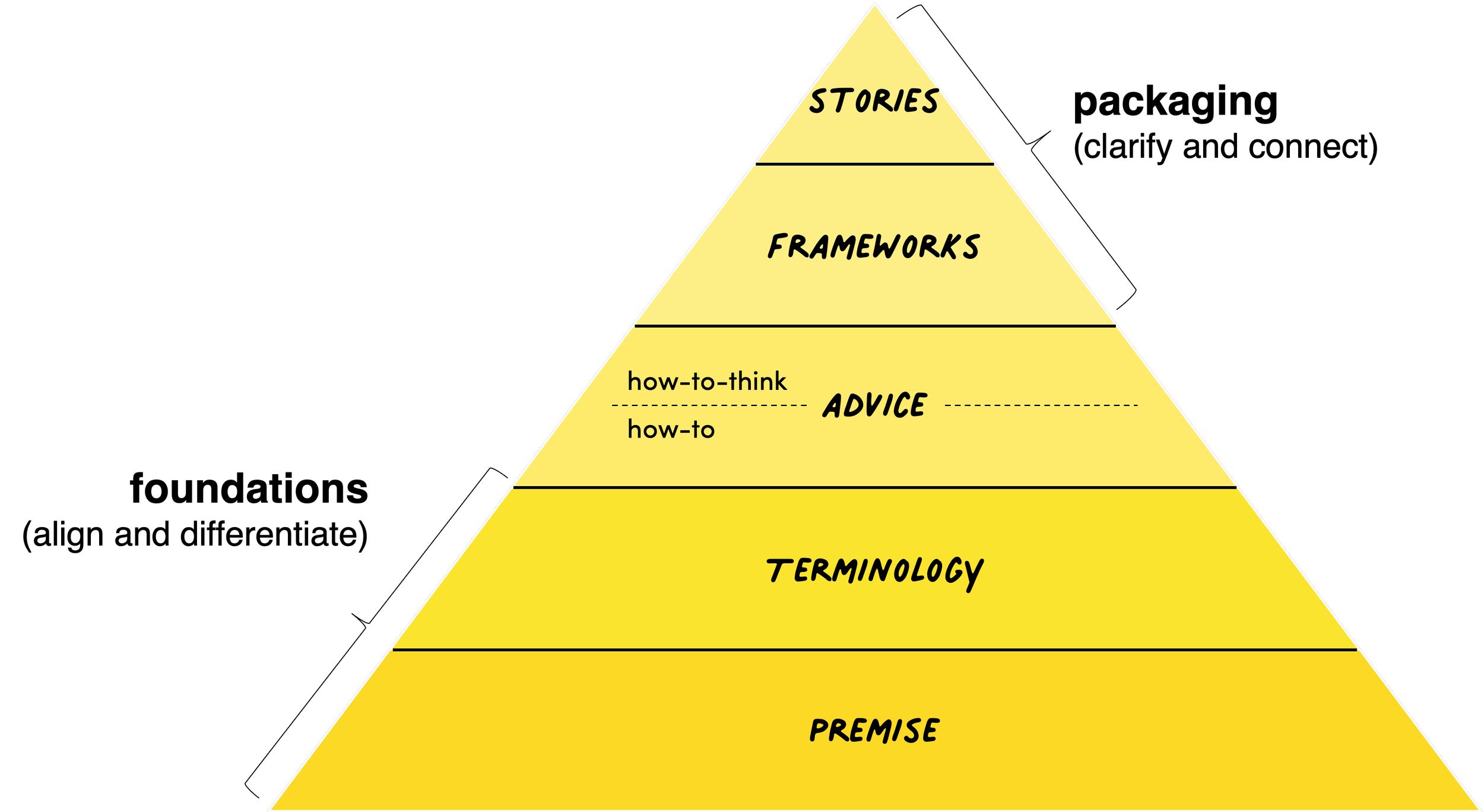
…Then move to the next arc!
OUTCOMES THIS CREATES
For yourself, internally:
Clarifies your own thinking — You're not guessing at what you mean; you're defining it through creation
Gets you reps and feedback — Audience reactions show what resonates, what confuses, what needs more work
Internalizes your ideas — For your next speech or guest appearance or conversation, this language feels natural
Builds your IP — Each arc might lead to reusable assets for speeches, website, proposals, client diagnostics, etc.
For your audience:
Shows your thinking process — They see you as a thinker and leader, not just a generic advice-giver
Invites them on the journey — "I'm figuring this out" is more compelling than "I have all the answers"
Demonstrates depth — You can explore your own ideas multiple ways, in deep, nuanced ways
Cements ownership — Repeating yourself matters!
For your business:
Content stops feeling random — Every piece connects to your premise, like 1 circle around your platform
Volume without burnout — One theme = multiple angles = easier to produce but still quality (no lazy AI slop)
SEO/AEO discoverability improves — Repeated exploration of specific concepts builds topical authority
Sales enablement — All this content becomes reference material for prospects researching you
Note: DISCIPLINE Is REQUIRED
This only works if you:
Commit a couple of weeks per arc (no jumping around topics randomly)
Publish multiple pieces per arc (you need multiple attempts to crack the code on your ideas)
Actually codify at the end (don't just "move on"—capture the IP, when it makes sense)
Source arcs from your premise language (not trending topics or random ideas—though any reactions to what is trendy can be pressed through the lens of your premise, like asking “how do *I* make sense of X?”)
The temptation will be:
"Oh, I should comment on this industry news" → NO. Stay on the arc, at least at first. You need evergreen IP, not randomly spikes of attention that die.
"I have this other idea" → GREAT. Add it to a notebook for safekeeping. Pursue it later.
"This arc is getting repetitive" → GOOD. That's when you and others both start to internalize your ideas.
Need a prescription for your output?
Try this:
Start with a longer-form piece to explore the big question or idea. Don’t judge it. Don’t worry if it encompasses ideas that you will tease out in their own posts later. Just create an earnest first attempt to understand.
Create 3-5 social posts over a 2-week span (LinkedIn or wherever you're most active)
End with another longer-form piece (something that represents the deeper question/idea or merely your updated learning from before; e.g. maybe the initial, more definitional piece leads into this final piece which references the definition of something but ultimately goes on to illuminate the idea through a framework or story).
1 codified asset as part of your IP (consider whether there’s something from your arc that deserves to be cemented into your IP as a visual, a branded term, an assessment tool, a lightweight guide, a signature story, etc.)*
Optionally: A culminating post that says "Here's what I learned exploring X for two weeks"
*Even ending an arc with a “signature bit” (a recurring way you explain something) helps you own your ideas.
HOW WE'LL BUILD YOUR ARCS TOGETHER
Together, we will:
Review your premise argument (whatever version we’ve got to this point)
Identify 5-7 potential content arcs (concepts/questions that need exploration)
Sequence them to avoid overwhelm
Define the questions/ideas each arc should answer/explore
Suggest content formats/angles for each arc (highly tailored to your preferences and needs)
Build a simple idea pipeline of content, structured around these arcs
The result:
In 3-6 months, you'll have developed significant IP, internalized your premise, helped orient your audience around certain key themes + win passionate new fans, equipping everyone with shareable language, and created a content library that fuels everything from speeches to sales conversations.
…all while clarifying your own thinking instead of guessing at what you should say.