What AI actually changes about selling group programs
Well, we're here again.
People are back to running around the internet claiming, "[Tactic] is dead!" As if they ever stopped.
Lately in my feed, that's been group programs: courses, cohorts, communities. Group learning is dead! Every coach, consultant, creator, and consultant/creator-coach I meet seems to be giving this type of program the ol' heave-ho out the door. Gone. Buh-bye. Closing time. One last call for alcohol, so finish your whiskey or beer. Closing time. You don't have to go home, but you can't stay here.
And if you're thinking, "Wow, that happened fast! It was almost [whips off sunglasses] Semisonic," then you and I just became best friends. I know my millennial kin when I meet them.
You'd also be correct! We're overreacting. Let's slow our roll a bit before we declare something useless. I don't think group learning is dead. It just tripped on some conventional wisdom and needs a moment to catch its breath. It's still alive and doing just fine, but as we help it back up, we need to whisper in its ear, "Hey, if you're gonna keep running, you need to change your stride, friend-o."
In other words, group programs can thrive and are thriving and will continue to thrive ... but only if we make one necessary change.
Because yes, this moment is pretty frothy. It's causing people to do odd things, like declare entire service categories "dead" or run around the internet singing late-90s pop-rock ballads. (Just me? Cool, cool.) But precisely because of the frothiness of this moment, we need to think more critically about what we sell.
(You remember "critical thinking," right? That's something humans can do. You know, unless we use certain technologies often enough, we stop doing it.)
(Seriously, WTF are we doing?)
Group learning and coaching programs aren't dead, but they must evolve.
This has nothing to do with AI or any other technology per se. Tools amplify and accelerate the user. Whatever is true about yourself and your thinking during your latest AI turn doesn't stop being true because you're now using that tool. If anything, it becomes more true.
That's why mediocre thinkers can now produce mediocre content at breathtaking scale. (The future!) AI doesn't help them create breakthrough ideas or memorable stories or any differentiated messaging or work. AI just helps them check boxes and fill feeds even faster. (Don't get left behind!)
It's also why obnoxious marketers are currently having a field day. If you previously had a proclivity to pummel people with pesky pings, then POOF! You're now the most powerful spammer ever experienced by humankind (which is not actually kind to humans, if you ask me). (You didn't, but I'm telling you anyway.)
Likewise, if you were already the kind of person to send hollow, templated DMs to "build rapport" with others, thanks to AI, you can now do ... whatever the hell this person is doing:
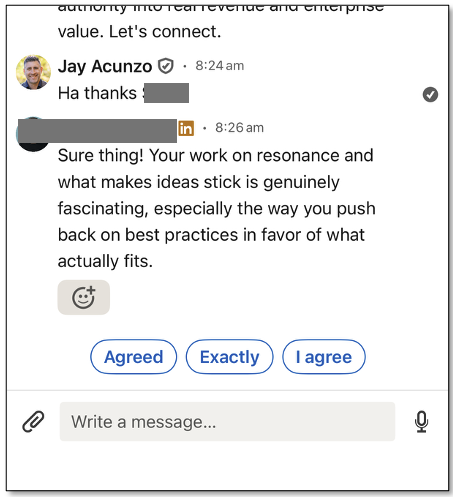
I ask again, this time with palms up to the sky:
WTF are we doing?
The theme of existence in 2026.
"WTF are we doing?" I'm thinking it constantly, texting friends the phrase daily.
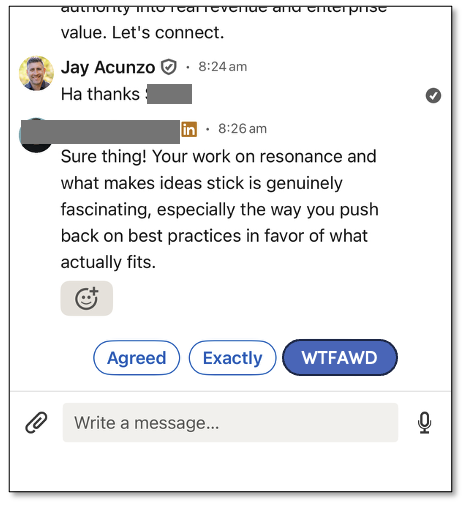
WTFAWD?
Here, I fixed LinkedIn's built-in reactions:
My friend, if you sell expertise, your business isn't dead. It does, however, need to evolve. Because we can't think about learning products the same way. This wasn’t caused by AI, remember, but AI amplifies what was already true: selling access to information is a weak value proposition.
We need to sell something else.
Stop selling information. Sell application.
Ever meet someone who refuses to publish their strongest ideas or methods? They think, "If I give it all away, they have no reason to hire me." THAT is the precise mentality which may indeed lead to something being dead: their business. Hoarding information is silly. People can access expertise everywhere, instantly. Expertise is table stakes to do the gig. If you're paid to consult, coach, or create, it's assumed. If others want to learn or do anything, they're well-served by information. It's application where things fall apart for them.
You need to sell that. Giving them more stuff behind the paywall is a flimsy value proposition. Again, it was true before AI; now it feels dangerous to proceed without embracing that truth.
If you sell access to information, you need to evolve. What was true before AI (you can't sell access to your expertise) is just thrown into sharper relief now (you must sell something else or risk your business).
What group learning needs to become (and fast)
There are three types of learning. (I heard this from a psychologist. This isn't my nomenclature...)
Verbal learning: learn by absorbing
Observational learning: learn by watching others do things
Experiential learning: learn by doing things yourself
The list above is written in order from least to most effective. Verbal learning is the LEAST effective. Experiential is the MOST effective. I'm speaking in generalities here, of course, as people learn differently depending on who they are and what they're trying to accomplish. (Though in my work helping others build their speaking business or build their business through speaking, it feels pretty obvious to me that when people claim they prefer to read or watch something versus do something, they're hiding. They're avoiding the discomfort of trial and error—but that's the actual work.)
Courses, communities, and cohort-based programs tend to over-index on pushing verbal learning, and I think that's a mistake they make. It's certainly a mistake I've made designing and selling some past programs. But not only is it the least effective way of learning for clients/members/participants, it's now being perceived as such.
People are starting to realize that merely getting a download of information isn't worth the price of admission. Not when information and instruction are everywhere for free. In the face of infinite online knowledge and also AI answer engines and basic-if-bad content creation, verbal learning becomes a weaker promise of value for us to rely upon when selling something (and it was already pretty weak to start).
As a result, one theory I'm forming—and I'm not 100% confident on this, but confident enough to stake my group program success on this in 2027—is that everything has to be built on experiential learning. Then it can be backed up by observational learning, both asynchronously (e.g. a library of examples or a video of an expert giving notes to your peer's latest attempt at something) and live (e.g. people getting real-time notes on a group coaching call). The prime value driver of a program is experiential learning.
This also affects positioning. If you're an entrepreneurial expert who sells programs promising "education" or a community group promising "connection with peers," then you're gonna have a bad time. You're promising verbal learning: the least effective and lowest perceived source of value. (Community groups are often a source of verbal learning unless positioned otherwise. The learning is just peer-led instead of instructor-led.) If that's you, consider how you might reposition the offering and maybe even redesign the product to center it more on action. Maybe it's not a course or community. Maybe it's an "accelerator." (For example.)
If people enroll, you aren't promising things they'll absorb. You're promising things they'll do and progress they'll make. It's active, not passive. Happily, it's active in a way that is also guided and clear and effective, because yeah, we've got education and peer connection in here, but so does everywhere else. The thing is, that stuff can’t be the entire point.
That means we downgrade stuff like video lessons and live talks in these programs in favor of assessments and re-assessments, whether self-guided or done with and by the instructor. These help the participant recognize where they stand, what's in the way, and what they should do next.
It also means we swap out some video lessons in favor of tiny tasks assigned, based on their assessments. If there's a video, that's only to explain why the task is the right next step. It's not meant as an exhaustive module to give them the download of everything, like an expert who over-explains things in a talk because they think more information equals more value.
In programs built on experiential learning, not verbal, completing tasks and achieving milestones are higher priorities than consuming lessons or getting advice. You might receive the latter, but the positioning and the true value of the program rests in the former. You're also there to be held accountable to forward progress, which happens when you take an action, not just regurgitate the right answer. (These programs are a type of learning that resembles an apprenticeship, not a college lecture.)
Ideally, when someone in the program completes tasks, they feel celebrated for it too. Participants could log progress and wins based on two types of actions: tasks meant to shape their behaviors and tasks meant to trigger outcomes in work or life. Both are needed. Both can be tracked and applauded in a group program, not just "learning stuff" in the broadcast-and-absorb sense.
In short, you have to do stuff. You don't just learn stuff. Turns out The Learning of The Stuff happens better when you are doing said stuff. That's experiential learning.
(Side note: The Learning of the Stuff was my failed B2B parody of The Lord of the Rings for a past marketing job.)
(Or was it? You decide.)
Anyways, this is new thinking, and I'm about three weeks into taking it seriously enough to develop my program for speakers in a new and better way. But I'm convinced that the more verbal learning is the focus of a program and its positioning, the less effective it is for folks enrolled AND the lower-value it is perceived to be. That's a terrible combination.
There are three types of learning. Experiential has always been the most effective and the highest perceived value. If we sell our expertise, we have to get our priorities straight when designing and positioning our programs.
Group learning isn’t dead. But selling access to information? That should be.